≈ Comments Off on Seeking New Patients: Old Hospital atop College Hill (WV) Re-Opens
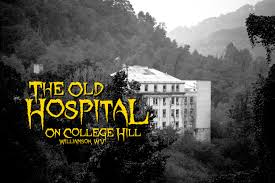
Sitting atop College Hill, Old Hospital closed for patients in 1988. New owners re-opened the facility for “new patients” who desire historical or paranormal tours today, February 5, 2021. The hospital was purchased by investors last year in order to preserve the stories of the City of Williamson and surrounding area of West Virginia. The hospital was featured in the Season 2 Episode 14 finale of Destination Fear, which originally aired in December 2020. Visit www.collegehillhospital.com for more information.
Keith Evans joins me tomorrow night to discuss the Hays House, a gorgeous Victorian house with a guardian angle and the bonds that link two families. Tune in at 9 PM EST on http://www.midnight.fm.
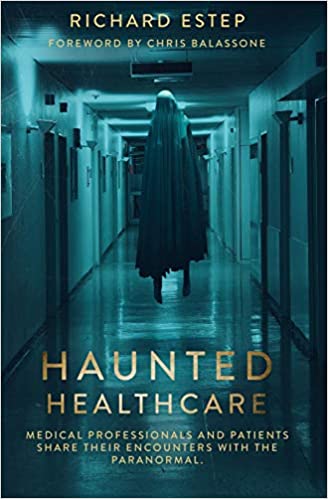
Richard’s book is on the left. The plagiarized book is on the right. A smiling Richard sits center.
Tonight, one of my friends posted a concerning update on his social media. One of his books was plagiarized, repackaged, and published on Amazon. Further, it appears that the author is a pseudonym. Authors spend a great deal of their own money to research and to write books. Few achieve financial success from their endeavors. Richard Estep is well known in the paranormal community. For an unknown, self-published thief to steal his work and publish as his own would not go unnoticed.
Richard Estep has written several non-fiction books on paranormal phenomena and appeared on various TV shows discussing his experiences. As a paramedic, Richard is especially interested in paranormal activity in and around hospitals. For Haunted Healthcare: Medical Professionals and Patients Share their Encounters with the Paranormal, Richard interviewed medical personnel and patients to obtain personal stories. The book was published in 2018 and is available in paperback or as an ebook. His extensive research landed him a guest role on Haunted Hospitals.
Let me be clear: His work was stolen. A person claiming to be Hugo Sulin published The Haunting of The Healthcare: A Collection of Ghost Stories Related to the Medical Professions: Haunted House Mystery Books on January 9, 2021. It appears on Amazon.com. “Sulin” reduced the page count by 2 pages and slashed the paperback price. But make no mistake. This is not his work. It belongs to Richard.
Once the crime was discovered, Richard acted. He alerted Amazon, which has not removed the fraudulent work (as of 11:22 PM on January 28, 2021). Friends and readers pointed the plagiarism out in reviews. Ultimately, Amazon disabled commenting due to the increase in activity. One would hope that they would have responded as quickly to the theft.
The paranormal community is small. Some profess “paranormal unity” but merely give it lip service. This is different. Tonight, the paranormal community stands firm in exposing this crime. Don’t support plagiarism. It is a crime.
Tonight, Bishop James Long joins me on The Haunted Librarian Show on http://www.midnight.fm. We’ll chat about his most compelling cases and his charity work. Tune in!
Coyote Chris Sutton joins me tonight at 9 PM EST on Midnight.FM. Chris “brings light to the darkest places.” He’s a Shaman and uses shamanistic healing work in his paranormal investigations. He’s a genuinely nice guy who cares about every aspect of our planet. I’m so excited to have Chris as my first guest of 2021. Let’s face it. We all need a little more light in our lives.
Tune in at 9 PM EST on Thursday, January 7th on Midnight.FM.
One of the decks in my growing collection is The Literary Witches Oracle Deck, written by Taisia Kitaiskaia and illustrated by Katy Horan. This 70-card deck includes females in literary history, as well as the materials needed for spell work, or in my case for items to assist in the interpretation of the spread. The cards fit into a sturdy paper box. This is a beautiful deck and supplements any tarot and oracle collection.
Oracle decks differ from traditional tarot decks, which are generally confined to 78 cards and resemble today’s playing cards. Tarot cards were initially created for game playing. Oracle decks are usually themed. They can be character-based, topical, or a combination. Like tarot cards, their size varies.
Oracle decks aren’t new, with an early example dating back to the Coffee Ground Cards, a 1796 deck housed in the British Museum archives. This deck incorporated images with explanations. As the nickname of the deck suggests, these cards were to be used in conjunction with coffee ground reading, where the grounds left in the cup were examined and a prophecy elicited from the images perceived along the sides and bottom of the white cup. It is similar to reading tea leaves. The decks have evolved over the centuries.
Oracle decks are incredibly popular. They’re easier to use. For instance, someone can pull a card a day for inspiration and guidance. There are angel decks and religious, predominately Christian, decks that appeal to those who fear or avoid tarot decks. (Yes, the hypocrisy is real.)
As with tarot decks, oracle decks have become collectible. I’ve got a mix of oracle and tarot decks in my collection. I was drawn to this deck due to the female literary characters. The women are international and quite diverse. The deck came from Taisia’s book, Literary Witches: A Celebration of Magical Women Writers (2017). Taisia “reimagines 30 female authors as true witches: not hooked-nosed creatures riding on brooms, but figures of radical creativity, originality, and empowerment.” The 40 additional cards enhance the deck.
As 2020 finally ends and 2021 begins, I did a 4-card spread with the deck.
My current situation is María Sabina, Healing.
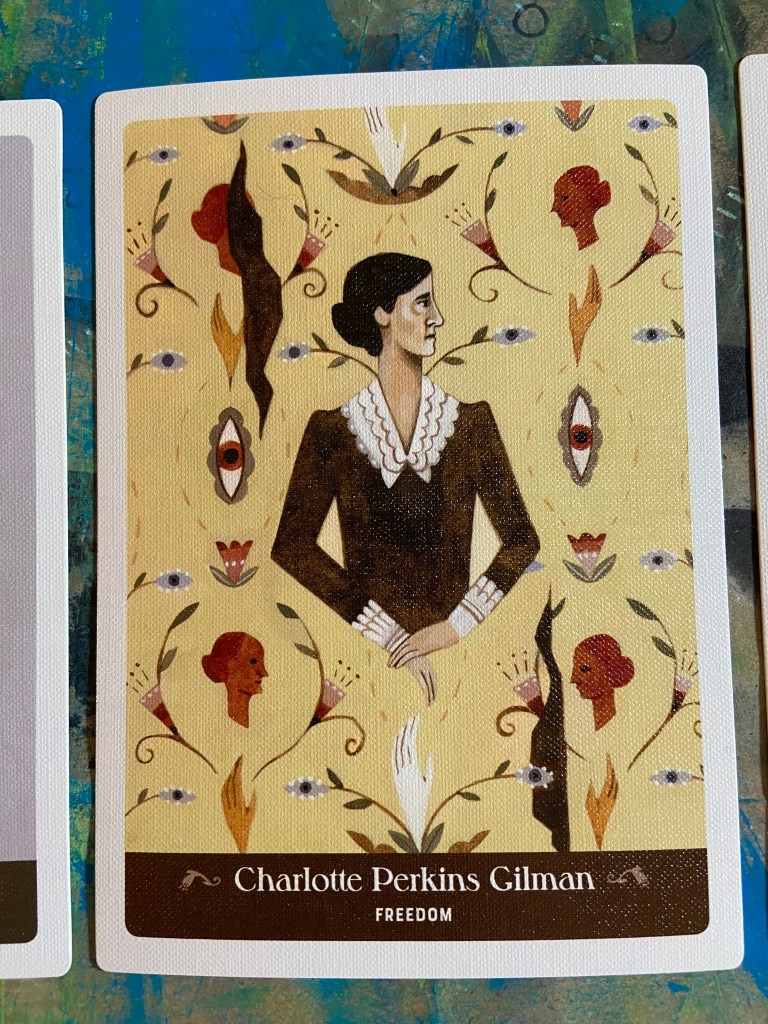
I need to be more like Charlotte Perkins Gilman, Freedom, to get me through 2021.
The Noose is holding me back.
I need to shed the House to move forward.
Interpretations: Honestly, this was a pretty good spread. I continue my treatment from breast cancer and am healing. María Sabina Magdalena García (1894-1985) was a shaman who wrote poetry. She was a Mexican healer known as the “priestess of mushrooms,” her preferred hallucinogenic.
I am expanding “The Haunted Librarian” in 2021, and the second card is incredibly fitting. Charlotte Anna Perkins Stetson Gilman (1860-1935) was a feminist writer who believed that “domestic mythology” (stereotypical role of the female to keep the house and perform the chores) had to be shattered in order for women to be liberated. Gilman wrote “The Yellow Wallpaper” (1892), which is considered an important piece of early feminist literature.
The Noose signifies anxiety and self-sabotage. I suffer from perfectionism. This is a warning that I need to organize and understand the concept of completion over perfection.
The final card is also apropos. My daughter is heading off to college next year, and I’ve got house envy. I would love to downsize and be more spontaneous in where I reside. Another meaning may be that I have left traditional employment and am focusing more on my writing and radio show. Who knows!
I’m satisfied with the spread. Likewise, I acknowledge that I am reading a lot into the symbolism. As I shed 2020, along with everything the year brought, I’m okay being optimistic about 2021. I want 2021 to be positive and inspiring. I think we all need it to be.
Visit the Sage Branch of the Bay County Library System to enjoy various examples of architecture with decorative elements and possibly a ghost or two. Henry Williams Sage (1814-1897) gifted the citizens of Bay City a library. Opening on January 1, 1884, the Sage Library remains a center of activity and enlightenment for the city. It may also have a ghost, or two.
Known as Michigan’s oldest continually open library, the Sage Library is stunning. Commissioned by Sage, the library was designed by New York architect Charles Babcock and supervised by the local architectural firm Pratt and Koeppe, with Andrew Thompson as the contractor. Sage invested $50,000 for construction, additional monies to initially staff the building, and donated over 8,000 books for the collection. He believed in public libraries, as well as the importance of debate skills. The 4-storey building had high school classrooms on the first floor; a library and reading room where a men’s debate club met on the second floor; and administrative offices for the Supervisor of Schools on the third. The basement housed the furnaces.
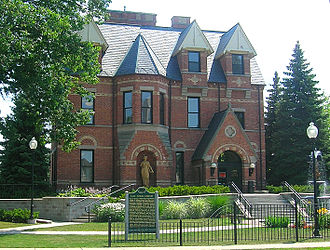
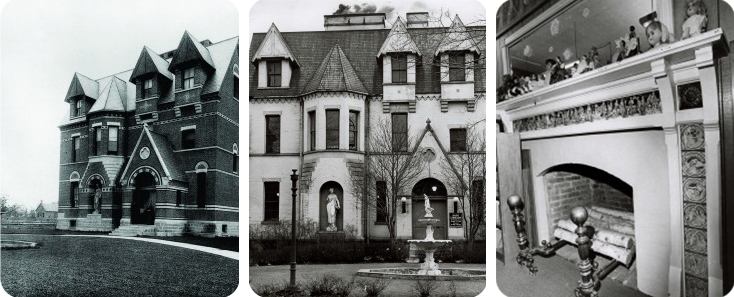
Image of Henry Williams Sage, “Leda and the Swan” fountain, the exterior of the library today, and a collage of historic images.
The architectural styles are many, with “French Chateau, Victorian Gothic, and Ruskin Gothic” styles prevailing. A beautiful fountain honoring the Greek myth “Leda and the Swan” sits outside the library. The library has been well maintained with many of the town’s businesses working on or in the building.
Paranormal author and investigator Nicole Beauchamp’s debut non-fiction book, Haunted Bay City, Michigan, was published this year. Nicole joined me for an episode of The Haunted Librarian Show and discussed one of her personal favorite hauntings: Jacob Beck.
Jacob Beck, Sr. owned and operated J. Beck & Son Steam Carpet Cleaning Works in the early 1900s. According to Nicole, Jacob laid new carpet in the Sage Library in 1904. Invoices reflect a payment of $11.36 for the installation and cleaning. In 1906, Beck was paid $5.18 to clean the carpets. In 1909, Beck died of a stroke at the age of 70.
Nicole and her paranormal group, Tri-City Ghost Hunters Society, investigated the library. The name “Jacob” came through on their ghost box. Upon further research, Nicole was told about Jacob Beck and his connection with the library. Listen to the archived show and/or read Nicole’s book for more information about Jacob, the Sage Library, and other paranormal activity in and around Bay City, Michigan.
Situated off the coast of Pinellas County, Florida sits the 1,136-acre Fort De Soto Park. The park has a complicated history—a history that is ripe for haunted stories. Tripping on Legends’ Christopher Balzano joined me on The Haunted Librarian Show to discuss some of the tragic stories. Curious about them, I decided to do a bit more researching. Two time periods stand out: The Mullet Key Quarantine Station and the 1980 Sunshine Skyway Bridge Collapse.
Five islands comprise the Fort De Soto Park. Visitors can access the park via boat or car. Inhabitants date back to 1,000 A.D. when the Tocobaga Native American Indians controlled the keys, as well as the Tampa Bay area, residing in villages. One hundred years after the Spanish explorer Pánfilo de Narváez and his men arrived in 1528, the tribe were extinct. By 1861, the islands came under government control and private use was prohibited. During the Civil War, the Union Army controlled two of the islands, Mullet and Egmont Keys. Various buildings were built over the years but ultimately were abandoned one-by-one by 1937. On May 11, 1963, the park was dedicated.
Tierra Verde, the official address for the fort, was originally part of Hillsborough County. Hillsborough County (Tampa and surrounding towns) was founded in 1834 and encompassed the western towns along the Gulf of America. Tierra Verde sits within Pinellas County, which was annexed from Hillsborough in 1912. Researchers should note the dates and keep in mind when searching for data on Fort De Soto Park.
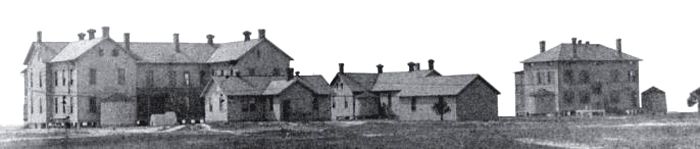
Two images of the now-gone buildings with an aerial shot of the park with a map of when the area was used by the government.
The Tampa Bay area experienced several Yellow Fever outbreaks. From December 16, 1889-1937, the Mullet Key Quarantine Station served as a short-term isolation center for travelers coming to Florida. The quarantine area housed 15 buildings. One was built above the water. The hospital sat 700 feet from the shoreline. Erected on pilings (wooden beams stuck upright into the water), the 37 by 200-foot station consisted of 9 hospital rooms. People who did not exhibit symptoms were housed inland, while patients remained in the hospital. However, people did die at the station.
By 1892, a fumigation apparatus was in use to eradicate the mosquitos, which transmitted Yellow Fever and the cases began to subside. In late 1937, Hillsborough County relocated the station to Gadsden Pointe, closer to Tampa, thus ending one quarantine chapter for the Tampa Bay area. Balzano’s new book Haunted Florida Love Stories (2020) retells some of the ghost stories, possibly identifying who the spirits may be.
Robert Raiola and Michael Betz were the 2 FDOT divers who recovered the bodies from the submerged Greyhound bus.
May 9, 1980 when a 1,200-foot span on the southbound lane collapsed. Bottom picture is of Robert Raiola (L) and Michael Betz (R).
On May 9, 1980, the MV Summit Venture crashed into the Sunshine Skyway Bridge, causing a 1200-foot span on the southbound lane to fall into the channel, killing 35 people. A makeshift morgue was set up on Mullet Key.
Michael Betz and Robert Raiola, two FDOT (Florida Department of Transportation) divers, were already planning on being at the bridge that day. This was Betz’ fifth day on the job; Raiola was training him. Both were eating breakfast at The Bunny Hut when the call came in. Upon arrival, the FDOT divers worked with Eckerd College’s Search and Rescue divers to retrieve bodies from the water. Betz and Raiola made two dives down to the upside-down Greyhound bus, where all aboard died (22 passengers and the driver), when another storm started moving in. Betz and Raiola were unable to retrieve all of the bodies trapped in the bus. Only 18 bodies were recovered on that day. Seven were recovered the next day by other divers.
Bodies were ferried to Andrew Potter Pier (also known as Potter’s Pier), on the southwest corner of Mullet Key. Here they were processed until being transferred to the Coroner’s office in Largo. Visitors to the park speculate that some of the ghosts seen may be those drowned in this horrific accident.
In addition to the possible victims of the bridge collapse, visitors claim to see phantom suicide jumpers.
Tune in with Christopher Balzano, check out his social links (https://trippingonlegends.com/), and consider ordering his latest book.
















 The Haunted Librarian
You must be logged in to post a comment.