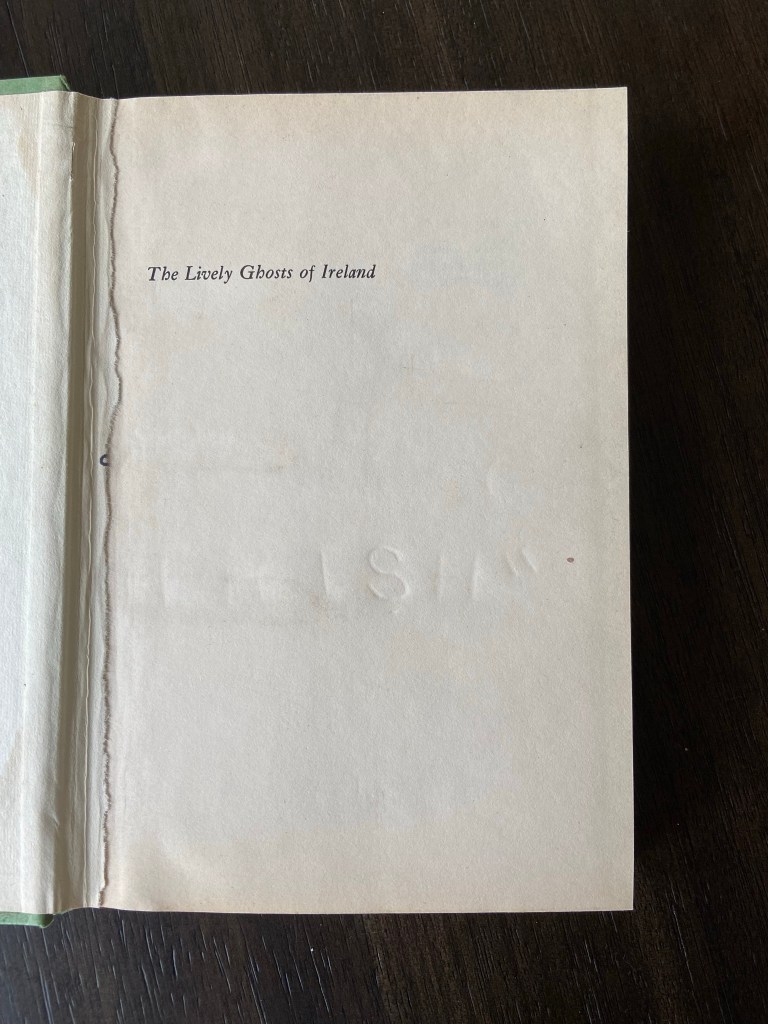
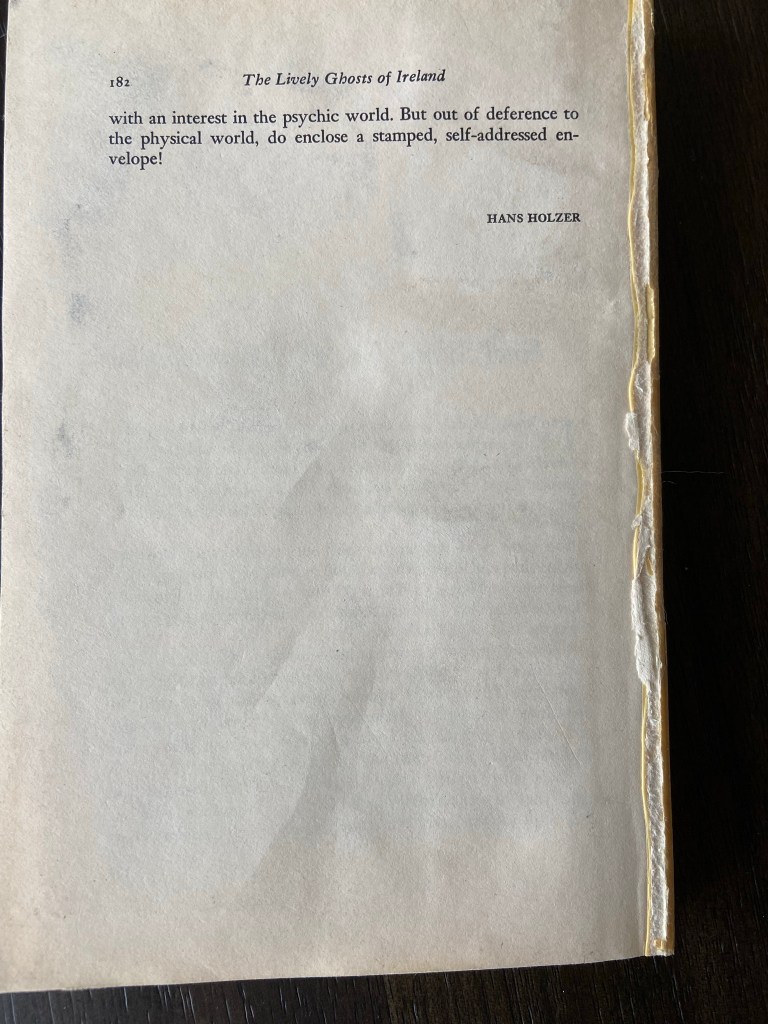
I alter books and create journals. Usually, I visit the local Goodwill store to select a book. This weekend, I went to the Goodwill in Gainesville, Florida, where I have recently moved. I didn’t find a book suitable for altering. It’s like a treasure hunt to find a book not too big, nor too small. Not too old, but not so new that the pages aren’t bound. It is a quest! I also purchase older books to gut for collage paper. I pulled a slight book with a green cover but not a back cover. No dustjacket, either. The pages were yellowed with age. I turned it over and read the back page. To my delight, I found a 1967 Hans Holzer book!
The book cost 63 cents. Well worth it!
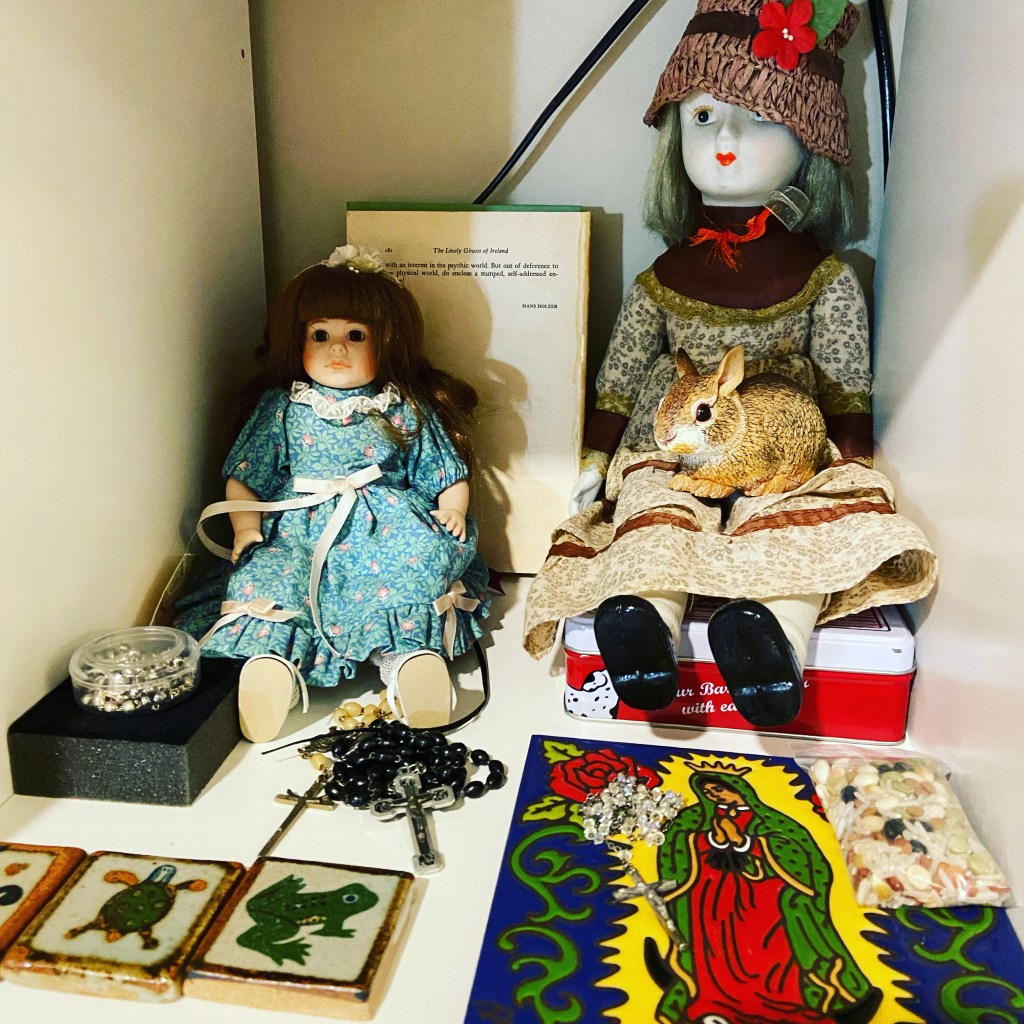
The Lively Ghosts of Ireland consists of 17 investigations Holzer conducted in Ireland. Countess Catherine Buxhoeveden (known then as “The Haunted Countess”), at the time Han’s wife, created 8 pen and ink illustrations. The book is incredibly fragile and will sit on a shelf with an eclectic mix of Rosary beads and porcelain dolls.
So, head on out to the thrift stores and locate your treasure.
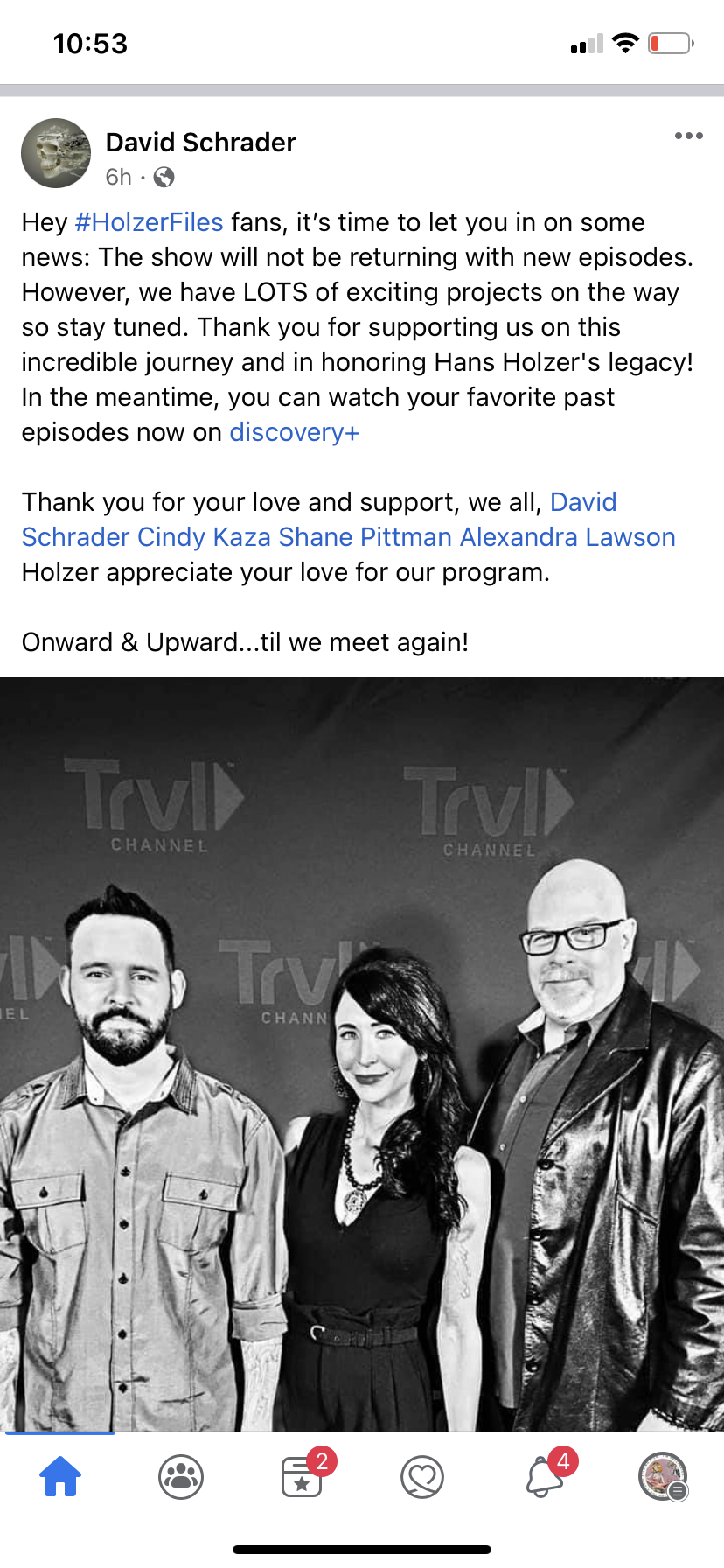
Last night, Dave Schrader broke the news that The Holzer Files will not return for a third season. The reality TV paranormal series finishes with 20 episodes (2 seasons) ranging from 2019-2021. The cast of Dave, Cindy Kaza, and Shane Pittman re-evaluated case files from famed parapsychologist Hans Holzer (1920-2009). Even though the series has ended, Dave announced that new projects are underway.
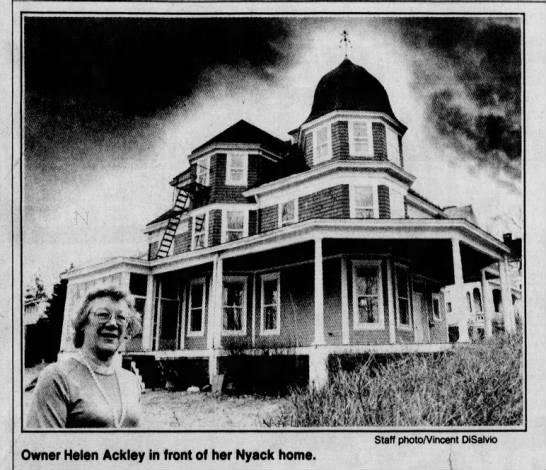
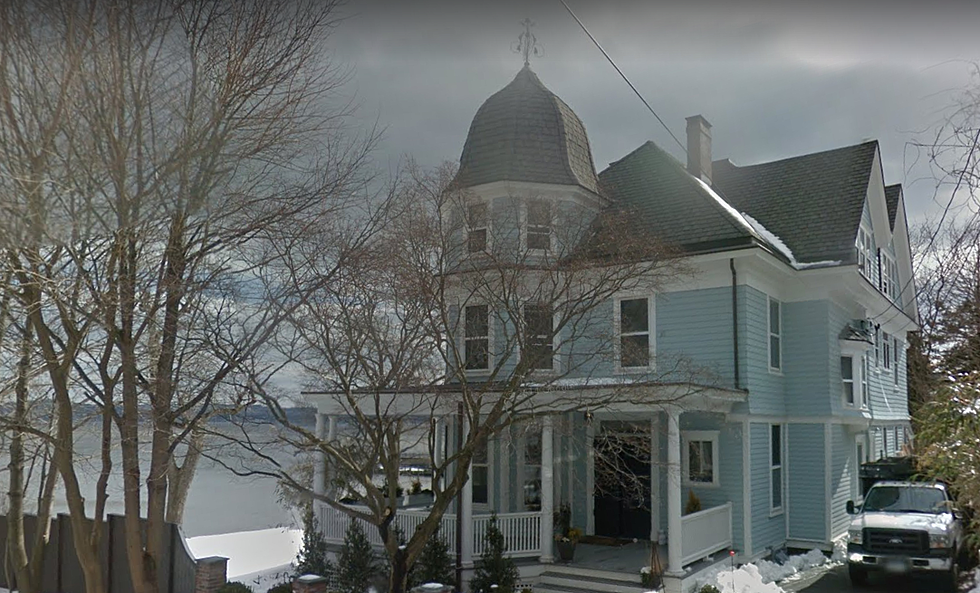
Helen Ackley in front of the 1890 Queen Anne house.
This court case, formally known as 169 A.D.2d 254 (N.Y. App. Div. 1991), is covered in nearly every law school class. Yet, many people falsely believe that the New York Supreme Court ruled the 1890 Queen Anne house located at 1 LaVeta Place, Nyack, NY was indeed haunted. What the Court did say was, “As a matter of law, the house is haunted.” Actually, the decision of whether or not the house was haunted was not before the Court. This case was a contract case; however, people enjoy discussing decades later. What is news: The “Ghostbusters House” recently sold.
Helen and George Ackley purchased the stately, though in desperate need of repair, 3-story, 4,628 square foot home in 1967. During their ownership, Helen boasted about three ghosts who resided with the family. One was a woman in a hoop skirt and the other was a Revolutionary War era couple called Sir George and Lady Margaret. (Sir George was dressed in a red coat and thus British.) Helen recounted the hauntings in the Reader’s Digest May 1977 article “Our Haunted House on the Hudson.” The instances were innocuous. Coins and trinkets left for the children. Gentle shaking of the daughter’s bed to get her up for school. Full bodied apparition nodding approvingly of the wall color choice. Helen took advantage of retelling the tales and included the house on haunted ghost tours. For all who resided in the tiny hamlet knew the house to be haunted. The couple who did not know were Jeffrey and Patrice Stambovsky.
Jeffrey and Patrice entered an agreement to purchase the home in 1990. They ponied up $35,200 in escrow funds and started learning about the small town of Nyack. They became concerned when local residents started telling them about the haunted house. That was when Jeffrey and Patrice wanted out of the contract and the escrow monies refunded. The Ackleys were unmoved.
The case wound its way up to the highest Court in New York. In the 1991 opinion, the Court found that the Stambovskys could, in fact, get their money back as they were not locals and did not know of the house as being haunted. The Court reasoned that the house was haunted “as a matter of law” since Helen Ackley endeavored to promote the house as such. Helen encouraged the label of “haunted” to be placed upon the house. She profited, if not monetarily, but by reputation. The case appeared to upend the widely held view of caveat emptor, or buyer beware. Indeed, Justice Rubin wrote how this case was an exception to strict application because of the facts and Helen’s silence.
Ownership has been steady over the decades since the Court’s decision. After the Stambovskys were able to get out of the contract, Canadian filmmaker Adam Brooks purchased and lived there for more than 20 years. American singer/songwriter Ingrid Michaelson resided there from 2012-2015, only to list the property due to her long-term absence from the large house. She felt the home “enchanting—but not creepy.” Simply put, she wasn’t there enough to justify the expense. American rapper Matisyahu purchased in 2015 and has been attempting to unload it since 2019.
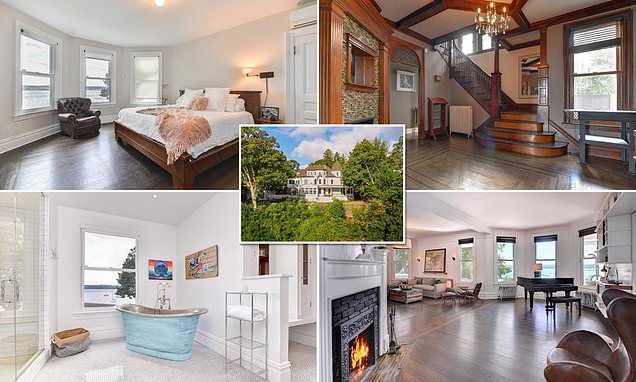
The house has been extensively renovated.
Originally listed on September 18, 2019, for $1.9 million, the price has lowered until it finally sold on March 29, 2021, for $1,795,000. Not too bad for a home that Justice Rubin believed whose owners would suffer financially if the Stambovsky contract were to be enforced.
So, what happened to the three ghosts? Every owner since Brooks has maintained that the home is not haunted.
Growing up in Fort Myers, I was fortunate to have parents who owned a boat. We would spend weekends out on the water, eating on Little Shell Island, and motoring up and down the Gulf of Mexico. When we were making it an all-day affair, we would head down to Collier County and look at the three odd houses perched on Cape Romano. The most famous was and remains the Dome House.
I didn’t appreciate my youth living on a canal where manatees swam and seahorses grew until I left. I guess that’s the age-old adage. Many years later and well into my adult life, I was able to spend the day on the water sailing past Cape Romano. While the Pyramid House and the Stilt House are long gone, the Dome House remains.
Bob Lee made his fortune in the oil industry which led to his ability to retire at the age of 44 and become an inventor. He envisioned an eco-friendly home where his family could vacation. The home would be off the grid and powered with renewable energy. He first built a prototype on his property in Gatlinburg, Tennessee.
In 1978, Bob purchased four lots on Morgan Island in the Ten Thousand Island chain south of Marco Island, Collier County, Florida. The island was pristine, unlike the rapid development taking over Marco.
Bob decided to build a home linking 6 dome structures all perched on cement stilts. Bob bought a barge, a flat motorized water vessel that easily transports equipment, and ferried over steel forms (molds) and 2 concrete mixers. He mixed the concrete with freshwater and built the domes. Bob installed under-dome heating via fire; the walls were insulated with foam. Dell Jones installed solar panels. Along the bottom of each dome was a gutter system the collected rainwater which was filtered for use.
If the house seems rustic, you’re wrong. It was actually quite lavish. Pinterest has a large collection of images. Carpet and tile were laid for flooring. There was air conditioning, satellite TV, and even a hot tub. It was the perfect vacation getaway.
Interior photographs.
The 2400 square foot 3-bedroom and 3-bathroom house was completed in 1982. Bob along with his wife Margaret and family enjoyed two years at the house. In 1984, Bob sold the property to George Wendell. Caretaker Brian Slager moved into the house. By 1987, the house was back in Bob’s name, and the family made it their primary residence.
John Tosto of Naples purchased the lots in 2005 for $300,000. He sought to develop and protect the home. Bob encouraged building a seawall; however, it was too late. The island was eroding beyond conservation.
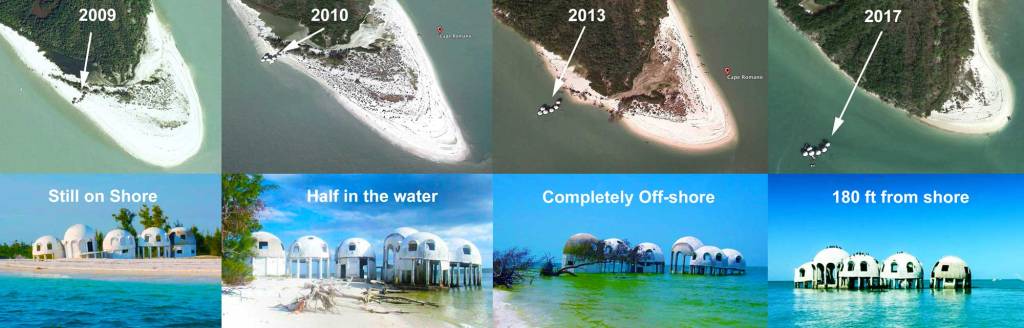
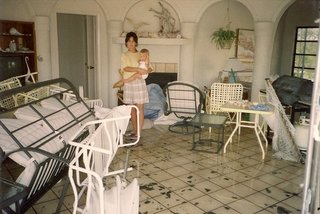
Mother Nature has not been kind to the island chain. All three houses had generous beach sand buffering them from the water. Over time, erosion and natural weather phenomena took away the sand. In 1992, the category 5 Hurricane Andrew destroyed the interior of the Dome House. By October 2005 when Hurricane Wilma churned past, the sand was eroded further. Two of the 6 domes fell on September 10, 2017, in Hurricane Irma.
1. Damage from Hurricane Andrew; 2. The Dome House sits abandoned.
After several years in court battling the land use of the Dome House, the State of Florida now owns the land while Tosto owns the structures. The house sits in the water and has become part of the Rookery Bay Aquatic Preserve. It is a destination for tourists and urban explorers. Sea creatures and birds have made it their home. Nature has reclaimed what was always hers.
The house is viewable only by water. As the erosion continues, there are growing fears for the safety of boats attempting to anchor or to sail close. Hire a licensed boat captain or company to sightsee. Never attempt to trespass.
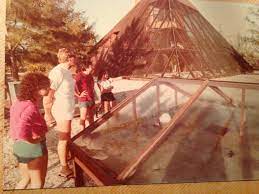
1. The 3 houses on Cape Romano; 2. The backside of the house; 3. The aviaries; 4. The front.
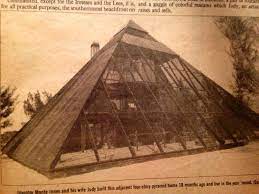
Cape Romano is an island just south of Marco Island, off Naples, in Collier County, Florida. Back before climate change was mainstream, people purchased lots of these fragile islands and built houses. Of the three on Cape Romano, the Dome House is the most famous. (Blog forthcoming). However, personally, I’m captivated by the Pyramid House. Not only did the family live in the structure, they brought their pets to join them in island bliss…until it wasn’t.
Cape Romano is the southern point in a chain of islands making up the Ten Thousand Islands off just south of Marco Island. At some point in the 1060s, entrepreneurial salesmen decided to sell plots on the beach facing the Gulf of Mexico. This was Florida’s “I’ve got a bridge to sell you” land scam. It was also before climate change became our generations danger.
Montague “Monte” Innes convinced his wife, Judy, that he could build a house on the island where they could live an almost off-the-grid lifestyle. And it worked for several years.
According to a recent interview with Judy, the plot was on Caxambas Island, part of the Ten Thousand Island chain. (Note: the landscape of the island chain has substantially shifted with erosion. The island boundaries have changed over the years.) Monte purchased a barge to bring over the supplies and with the assistance of a friend named Harry, they constructed the 3-story cedar pyramid-shaped house.
Honestly, Monte, and with the Dome house builder Bob Lee, were decades before their time. Both men devised ways for the families to survive and thrive with solar power for Bob and windmills for Monte, generators, and water filtration systems. Judy and Monte even had a waterbed! Monte used extra pilings to secure the floor.
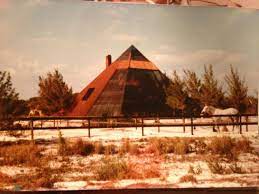
The house had rooms butted against the front wall and a large 3-story lanai along the back. What made the Pyramid special were 4 golden mirrors placed upon the top. Sunshine reflected off the mirrors, resembling the Egyptian pyramids. The other feature consisted of a menagerie of animals Judy kept. Monte built 5 aviaries for Judy to breed birds. Five emus had full run of the island.
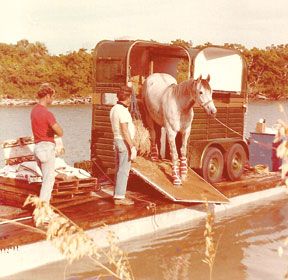
Online forums house postings from people from all over who passed via boats the homes while growing up. As the homes were only accessible by watercraft, the homeowners had to bring over supplies and animals on barges. The horses are the most discussed topic. Judy brought over two horses, Notice Me (Twiggy) and Koko individually in a horse trailer fastened to the barge. They arrived in 1978. By May of 1987, Judy removed the horses and relocated them to her Naples property.
1. Bringing each horse over on the barge; 2. The horses with the house in the background.
The youngest daughter, Heather, was a high school student while residing on the island. Each school day, she took a small John boat to Marco Island to get to school. What an incredible life!
In 1988, Judy was injured while riding a horse and never returned to the island. Monte and Judy divorced; Heather would look after the animals and began to bring them to mainland.
Shortly after Judy and Monte sold the pyramid house to a couple from Ohio, it sustained great damage from a hurricane. Judy says a tornado brought down the house.
Erosion, however, was always on their minds. When they constructed the pyramid, there was roughly 2,000 feet between the house and the water. Rapid erosion quickly diminished the distance, and then Mother Nature finished it off.
The area is not haunted—that I know of. However, it is a part of my childhood, having seen the houses and heard the talk, and I wanted to share that Florida is known for some odd things. And a cedar pyramid on an island in South Florida is one of them!
Marco Island is the populated area on this aerial map. Cape Romano and the islands are to the right.
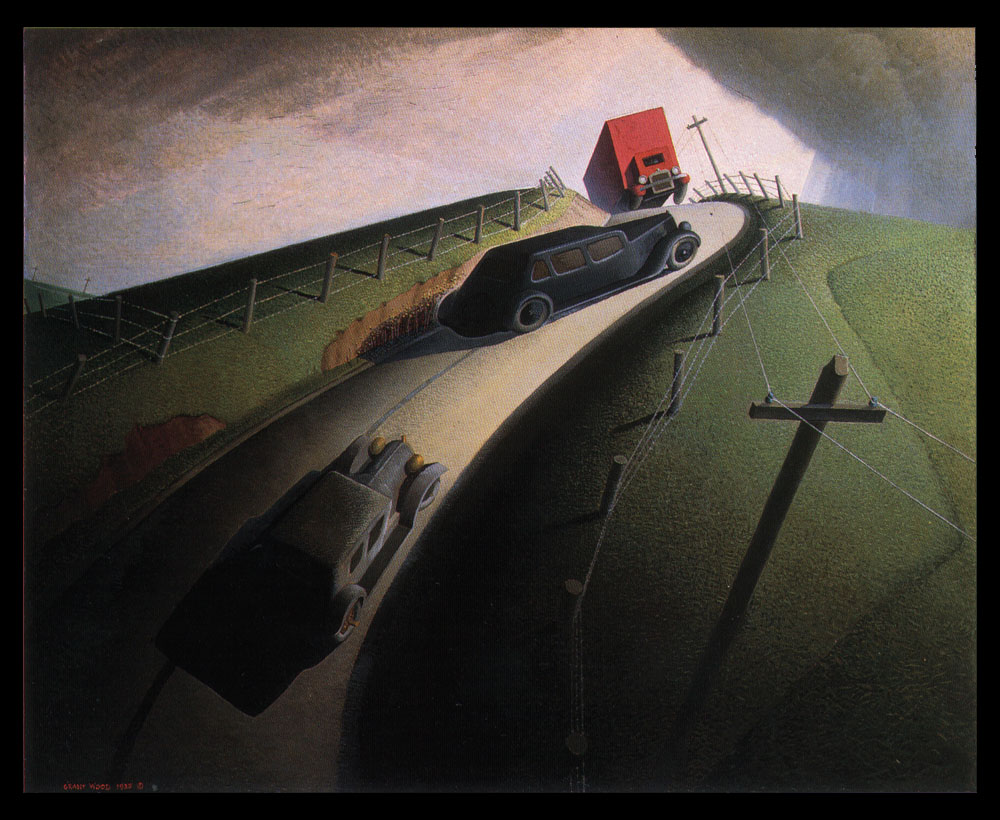
Death on the Ridge Road (1935) by Grant Wood and Strange Shadows (Shadow and Substance) (1950) by Gertrude Abercrombie.
Paranormal Art Exhibit Opens in Toledo
The paranormal sells. The Toledo Museum of Art’s Supernatural America: The Paranormal in American Art runs from June 12, 2021-September 5, 2021. Curators assembled nearly 160 objects with possible links to the paranormal. The items include paintings, mixed media art, photography, clothing, and objects. This exhibit marks a return of viewing the relationships between art and the paranormal.
Probably the most famous painting in the exhibit is Death on the Ridge Road (1935) by American painter Grant Wood (1891-1942). The painting’s interpretation begins with the influence of the rural car crash of Jay Sigmund, Wood’s friend. Sigmund’s index finger required amputation from the crash; however, there were no fatalities. Sigmund would publish a book of poetry titled The Ridge Road, seemingly processing the traumatic event through writing. Critics have written extensively about the meaning behind the painting. Over the years, it has become intertwined with death due to its use as an illustration in the 1935 essay “…And Sudden Death” by J.C. Furnas, where he writes graphically about the increase of highway deaths occurring across America in the 1930s. American composer Cole Porter (1891-1964) purchased the painting for $3,000 sight unseen. It is on loan from the William College Museum of Art.
To be sure, I’m unmoved that this painting is linked to the paranormal. It isn’t about a death on the road. Even the painter’s mother was ill, there isn’t evidence that he was painting about her impeding death. It seems that the interpretation is more of the conflict between rural and urban living or the painter’s sexuality. However, displaying the painting draws in visitors. That’s a plus.
The second famous painting is Strange Shadows (Shadow and Substance) (1950) by Gertrude Abercrombie (1909-1977) which is closer to a paranormal theme. Abercrombie was a surrealist painter who was labeled a magic realist. A vast number of her paintings were self-portraits, incorporating magical motifs. Here the “Queen of Bohemian artists” conjures up a moody self-portrait with objects associated with the paranormal. This is worth viewing!
Agatha Wojciechowsky’s Untitled (1963).
The most sought-after artist for people in the paranormal field will be Agatha Wojciechowsky’s Untitled (1963). Agatha (1896-1986) was a medium healer and an artist. She knew early on that she had a gift. In 1951, Agatha worked with her spirit guide Mona and took up automatic writing. Agatha would enter a trance-like state and draw. Eventually, she would begin using watercolors. Agatha was an ordained minister in the Universal Spiritualist Church and active in the New York Spiritualist community. Here is a short film where Agatha enters her trance and paints: http://collection.folkartmuseum.org/people/2219/agatha-wojciechowsky. Please watch.
The exhibit is a traveling exhibit heading to the Speed Art Museum, Louisville, Kentucky and then the Minneapolis Institute of Art.
Even if the museum’s exhibit is a tenuous attempt at linking the broad subject of paranormal to artwork, it is a start. I look forward to other museums following suit.
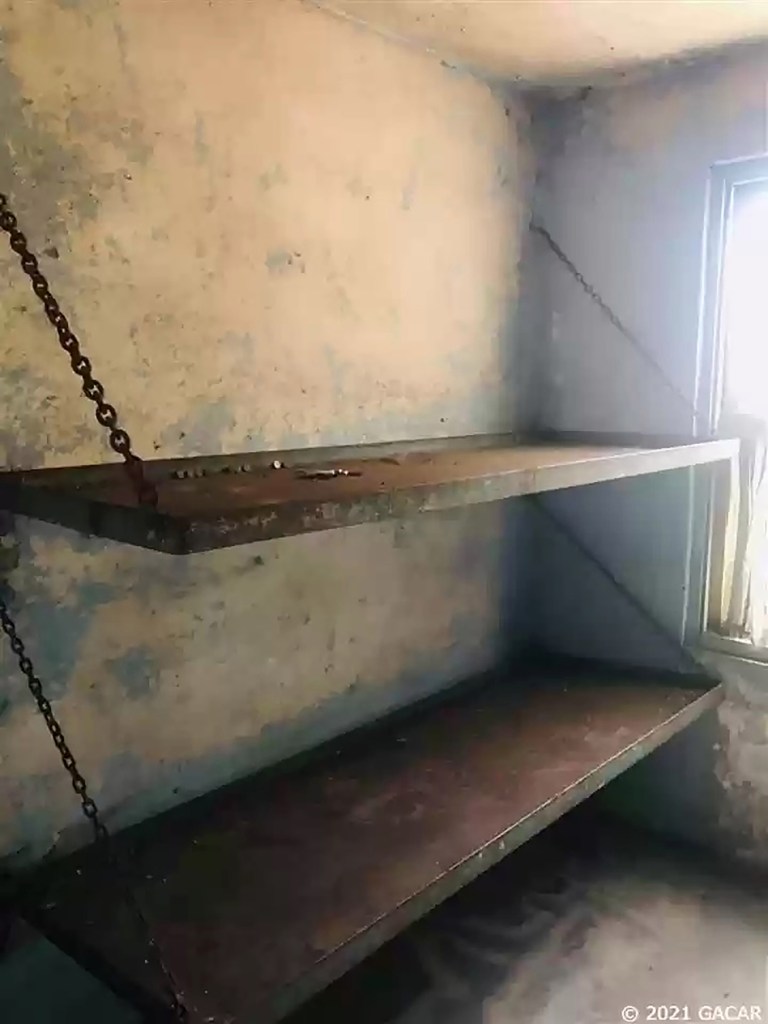
Three interior images of the jail and 1 exterior image. All from the online real estate listing.
The “certifiably haunted” Old Gilchrist County Jail has sold. On June 4, 2021, Cheryl and Lee Irwin purchased the 2,078 square foot jail for $117,500. The former owners, Gary and Arlene Hale, purchased the old building on March 10, 2005, for $30,000. Ms. Hale maintained the property until she decided that she was getting too old. The new owners are looking to expand the events by adding an AirBnB. For many in the paranormal community, this location has yielded a lot of evidence of multiple hauntings.
The 2-story jail was built in 1928 with 8 cells with toilets and sinks. For decades, the county sheriff’s department did not employee overnight staff. It wasn’t until 1965/1966 that a jailer’s quarters were added so that there were employees guarding prisoners through the night. The jail ceased operations in 1968. Since 1980, when the county property records were added to the database, there were many owners—even a few who re-deeded the property after deeding to another person. Hmm.
The interior has not changed in the 50+ years since it closed. Metal beds and doors appear original. The building has little graffiti and is ripe for investigations. Several articles announcing the sale do, however, have some of the facts incorrect.
First, there was only one officer technically killed in the line of duty.
Tombstones for Deputy Sheriff Sidney L. Slaughter and Sheriff Eli Mark Read.
In 1934, the sheriff’s deputies did not work overnight shifts. Therefore, merchants hired off-duty officers as watchmen. Deputy Sheriff Sidney L. Slaughter, age 32, was working at a grocery store on the night of January 22, 1934, in Trenton, Florida. Three bandits initiated a “midnight gun battle” while robbing the store. Deputy Slaughter was able to get off three shots before being fatally stricken. One of the bandits fired a bullet that broke Slaughter’s neck. He died at the scene. The only witness Mrs. Caswell merely heard the shots fired but did not see the robbers. The case remains unsolved. A theory at the time was that the robbers were the same men who kidnapped and beat another Gilchrist County deputy weeks before. That officer resigned. Unfortunately, Deputy Slaughter was hired to replace him. “Thy valor shall be unforgotten” is inscribed on his tombstone.
The second death was in 1956. Sheriff Eli Mark Read had only been appointed to the position a few months prior when he was killed. On Sunday, December 9, 1956 (which horribly was his birthday), Sheriff Read was responding to a complaint from Edward Conner and Claude L. Rodgers about their father and father-in-law drinking and brandishing a shotgun. They believed him to be dangerous. Several attempts to disarm him were unsuccessful. They drove into Trenton to get the Sheriff to disarm the man.
The man was Harley Austin Conner, age 55, of Bell, Florida, a tiny town in Gilchrist County. Conner was made aware by his family members that Read was coming out to relieve him of his gun. Sheriff Read honked his horn while pulling his car onto the property. He exited his vehicle, walked around, and was returning to his car when he was shot in the stomach and arm. He got into his car and radioed to Mrs. Robert Dodson that he was shot. Read drove his car into a tree. Conner’s neighbor, Amos Philman, found Read and drove him to an awaiting ambulance in Trenton. Read was transported to Gainesville, Florida, where he died three hours later. He had 8 shotgun pellets (buckshot) in him.
Conner was located at another son’s house. Leonard Conner testified that his father initially admitted the shooting but appeared intoxicated. In addition, Sheriff Read told several witnesses that Harley was, in fact, the shooter; however, the state had to prove their case in court. A jury rejected Conner’s defense that he was not guilty for reason of insanity and found him guilty of 1st degree murder; he was sentenced to death. Conner was electrocuted on June 1, 1959.
In a few articles, paranormal investigators claimed to have communicated with Willie James Ellison, a man who was killed in 2008. This is one that seems dubious.
Willie James Ellison.
Willie James Ellison (12.9.1969-5.31-6.1.2008) was incarcerated several times during his life. However, none of the instances were in Gilchrist County, and most certainly never in the old jail. Willie had a cocaine habit. He also sold the illegal drug. On April 16, 2007, Willie was released from the Florida Department of Corrections. He returned to Trenton and resumed family life. However, something went tragically wrong for Willie between May 31-June 1 of 2008. During that 2-day period, he was shot twice with a 12-gauge shotgun. It took several days for Willie’s body to be found. On June 4, Willie’s body was discovered on Tyler Grade Road by someone passing by. (Note: The medical examiner placed the date of death between those days.)
Samuel Lane Pittman, age 29 at trial in 2011, was arrested and charged. Just prior to the commencement of his trial, Pittman struck a no contest plea deal whereby he confessed to manslaughter and was sentenced to 9 years, 3 months, and 14 days in jail. According to the inmate database, he remains incarcerated.
I see several flaws in Willie haunting the jail. First, he was never incarcerated in that jail. Nor was he incarcerated in Gilchrist County. Second, his body was not found close to the jail. In fact, he was found outside of town. Sure, he resided 5 blocks from the jail, but why would he want to haunt it? I need more evidence.
The new owners are beginning to add content to the website, https://oldgilchristcountyjail.webs.com/. Even though there are historical inconsistencies in the reporting of the hauntings, you should still give it a try. This may be an ideal location to learn how to properly investigate and to learn how your equipment works.
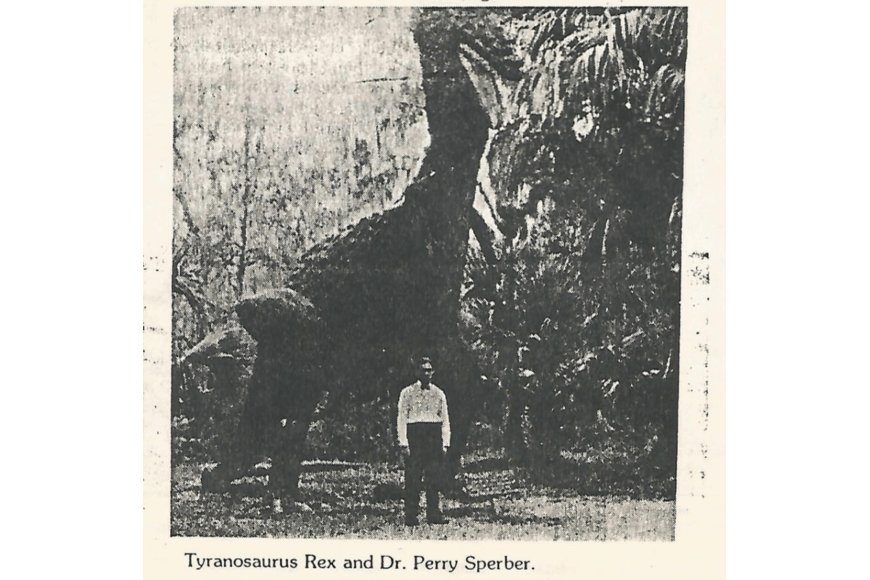
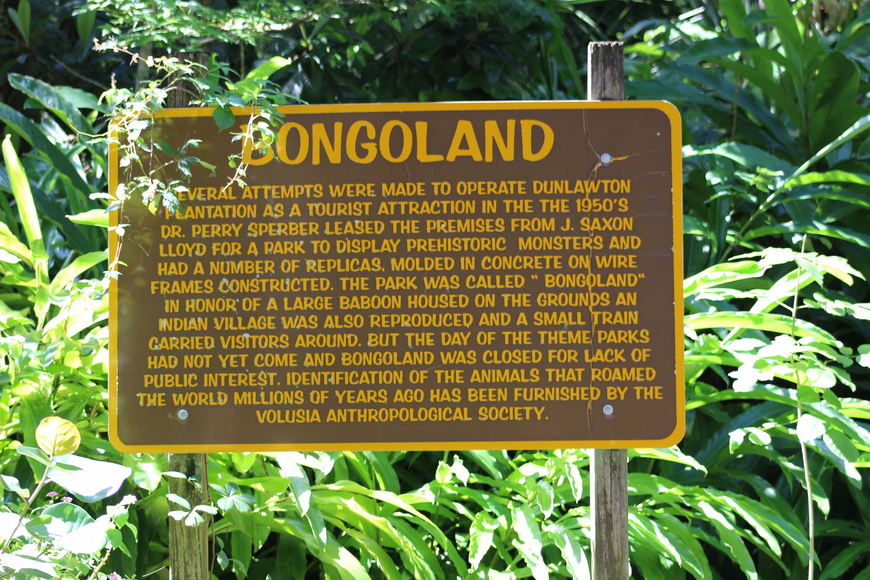
Bongoland was a roadside attraction that operated between 1948-1952. It was the brainchild of Dr. Perry Arthur Sperber (1907-1996), who leased the land in Port Orange, Florida from Daytona car dealer J. Saxon Lloyd. It was doomed from the beginning.
Florida has a long and rich cultural history, and Port Orange is no exception. Situated south of Daytona Beach, the area saw Franciscan monks founding the Lost Mission from 1602-1625. The coquina shell walls of the mission are in ruins yet explorable today. (They failed at persuading the Native American Indians to convert to Christianity.) In 1763, the English Crown deeded 101,400 acres to Dr. Andrew Turnbull, who exploited the land and the slave labor.
Bahamian native Patrick Dean purchased 995 acres in 1804, establishing a plantation. He was killed by the Seminole Indians in 1818 during the First Seminole War. The land passed via will to his aunt, Cicely Green Bunch, whose husband was Patrick’s uncle and owned adjacent property. According to records, it appears that Cicely predeceased Patrick and her share went to her grandson upon her husband’s death. The grandson by then was Admiral John Bonnemaison Bunch McHardy, who favored the military over farming. He sold the plantation to Joseph and Charles Lawton on May 3, 1832. Later that year, the brothers sold it to Sarah Petty Dunn Anderson for $4,500. Sarah’s sons, James and George, ran it for three years. It was during this time that the land became known as Dunlawton.
Dunlawton burned during the Second Seminole War, 1835-1842. By 1838, it was rebuilt, only to burn down again in 1856 during the Third Seminole War, 1855-1858.This time the plantation was under new ownership. John F. Marshall paid $8,000 for the land on September 18, 1846. Marshall attempted to bring the plantation back to life, only to fail. He decided to lease the property with a right to purchase to Charles P. Vaux, who also failed, in 1853, and the property reverted back to Marshall in 1855. Upon the third and final burning, the plantation ceased to be agriculturally viable.
The Civil War interrupted the timeline, as Confederate troops used the property for camping. After the Confederates lost and surrendered, Marshall was able to locate a buyer, attorney William Dougherty, who sought to subdivide the land and sell it piece by piece. The last person to own the property was Joseph Saxon Lloyd (1907-1991). Somehow Dr. Sperber was able to pitch the idea of building huge dinosaurs amongst the fauna, set up a Seminole Indian village, and small zoo in an attempt to lure vacationers traveling by car to stop in. A baboon named “Bongo” gave the attraction its name: Bongoland.
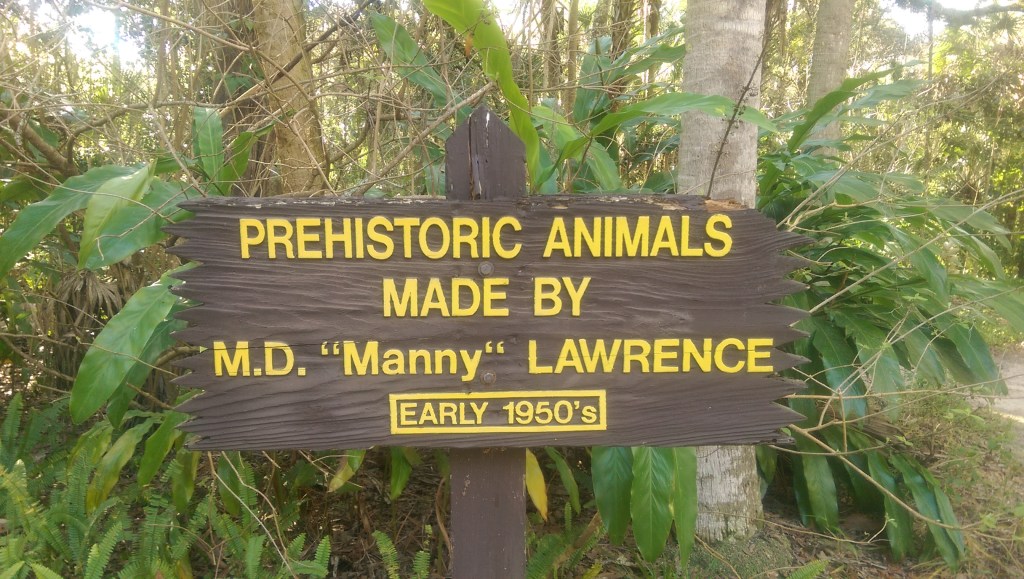
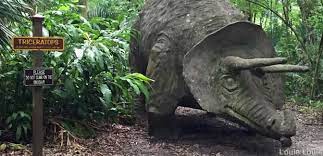
Manuel David “Manny” Lawrence was a sculptor and cement worker. He created the dinosaur statues, of which 4 survived (spoiler coming). Manny build a 42-foot Tyrannosaurus Rex; 30-foot Stegosaurus; 25-foot Triceratops; and an 8-foot Dimetrodon. His work was known throughout the area as he worked at the Museum of Natural History in Holly Hill, Florida. Manny died in 2003 at the age of 79.
Advertising the park was expensive and ultimately led to its closure. Although the live animals were removed, the dinosaurs remained. In 1963, Lloyd donated the entire property to Volusia County. In 1972, it was added to the Florida Historical Registry. The Botanical Gardens of Volusia, Inc. began maintaining the property in 1988. The Dunlawton Sugar Mill Gardens are a unique place. Even though the plantation and mission and odd mini zoo are gone, the county realizes the interest it generates. It is one of a few abandoned locales that encourages people to explore. Call ahead to check on seasonal hours.
Dr. Perry A. Sperber wasn’t finished with dinosaurs. In 1970, he published Sex and the Dinosaur, where he theorized that animals are direct ancestors to the dinosaurs. Before his death on October 4, 1996, Dr. Sperber made the rounds discussing Bongoland and his book.
And now for the spoiler: In 2019, the T-Rex crumbled and fell. Apparently, it is unable to be salvaged and restored; however, several groups have offered assistance. Decades of extreme Florida weather claimed the mighty dinosaur.
In 1897, architect Horace Trumbauer commenced construction of a 70,000 square foot home consisting of 55 bedrooms and 20 bathrooms at 920 Spring Avenue, Elkins Park, Pennsylvania. The 110-room Neoclassical Revival Lynnewood Hall was completed in 1900. The owner, Peter Arrell Brown Widener (known as P.A.B. Widener), had known grief even before moving in.
P.A.B. Widener grew up poor. He trained as a butcher and saved his earnings. During the Civil War, Peter was able to secure a government grant to supply mutton to Union troops. Peter turned the $50,000 in 1860 dollars and co-founded the Philadelphia Traction Company. In 1858, he married Hannah Josephine Dunton, known as Josephine. Together they built one of the wealthiest family empires in America.
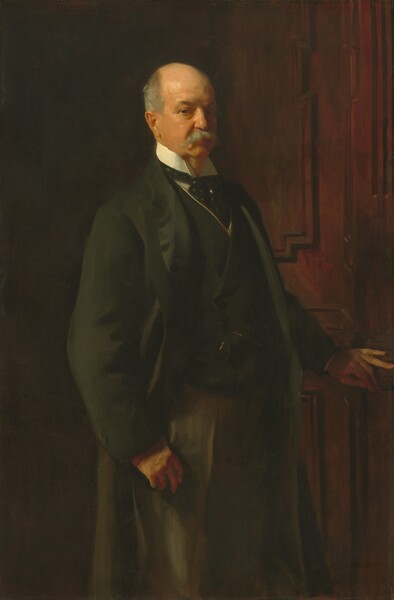
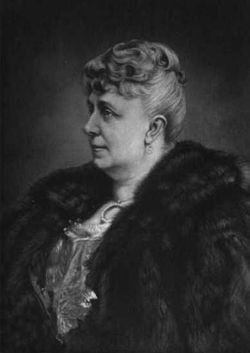
The famed portrait painter John Singer Sargent painted Pere S.B. Widener (1) and Mrs. Joseph Widener’s (2) portraits. Another renowned painter, Augustus John, painted the portrait of Joseph (3). Mrs. H. Josephine Widener is shown in picture (2).
The couple’s hard work paid off. They amassed a fortune beyond belief, all the while remaining true to their Episcopalian beliefs. However, like all families, they suffered their share of heartbreak. Their firstborn child, Harry Kern Widener, died of typhoid fever when he was about 11 years old in 1871.
As P.A.B. began to wind down his business dealings, he purchased a yacht, christened Josephine after his beloved wife. The large vessel was fully staffed and prepped for a 2-year cruise around the world in 1896. Peter and Josephine were joined onboard with the remaining sons, Joseph E. and George Dunton, and their families. The vessel was heading to Bar Harbor, Maine before heading off on the worldwide voyage. Josephine was not well leading up to the trip and was eager to set sail for warmer climates to heal. However, on the evening of July 31, 1896, the physician was called twice to attend to Josephine. Believing she was resting comfortably for the night, the doctor returned the following morning to find her dead from heart disease. The Philadelphia newspapers were bereft in the sudden death of the beloved citizen. Mrs. Widener’s corpse was returned via the Reading Railroad for her final resting place in the family mausoleum. In 1898, Harry would be reinterred beside his mother.
Although P.A.B. did find a small amount of pleasure sailing aboard the Josephine, he turned his attention elsewhere: Building a large home to house his growing family and his huge art collection.
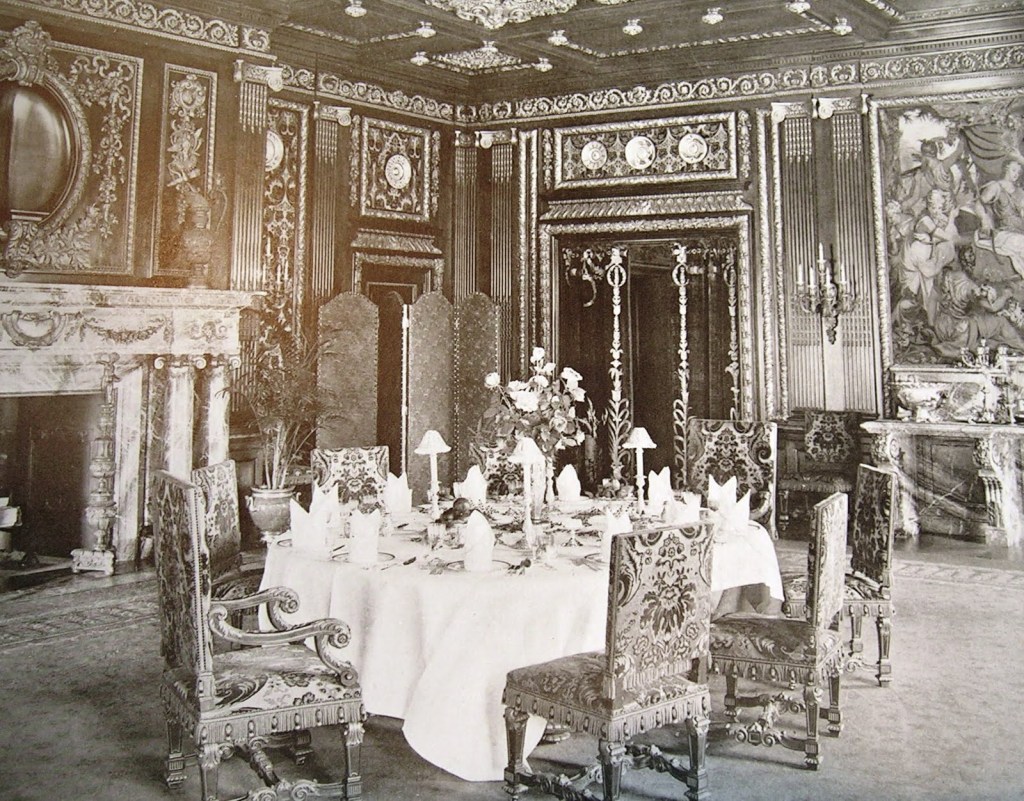
Lynnewood Hall “dripp[ed]” in luxurious items. Nothing was spared in the décor. By now, P.A.B. decided to invest in the International Mercantile Marine company with J.P. Morgan. Int’l Merc owned the White Star Line, and their infamous ship the RMS Titanic. Peter’s third son George, his wife Eleanor, and adult son Harry Elkins boarded the ship on her maiden voyage to return from Europe. Although Eleanor and one servant survived by boarding one of the lifeboats reserved for 1st Class passengers, George, Harry, and the other servant were not so lucky. They drowned when the ship sank in 1912. This added more heartbreak to Peter, who by now was residing in Lynnewood Hall.
On November 6, 1915, Peter was found dead in his bed at the sprawling estate.
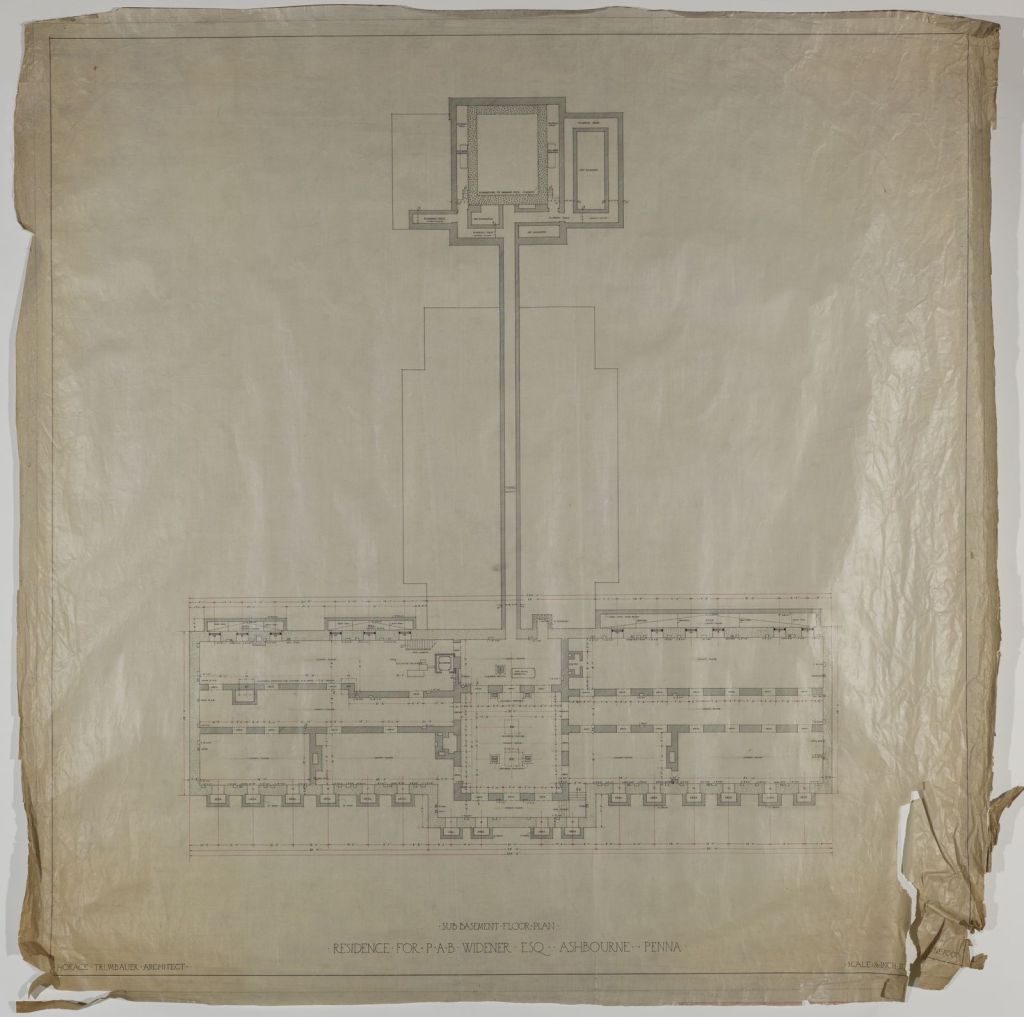
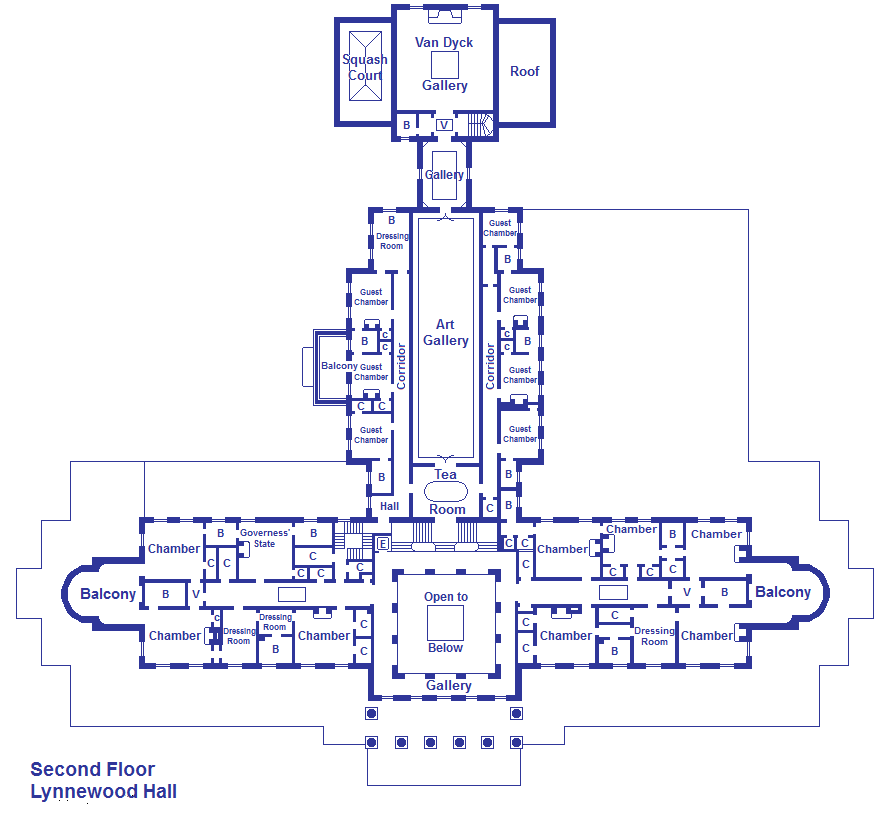
Floorplans of Lynnewood Hall.
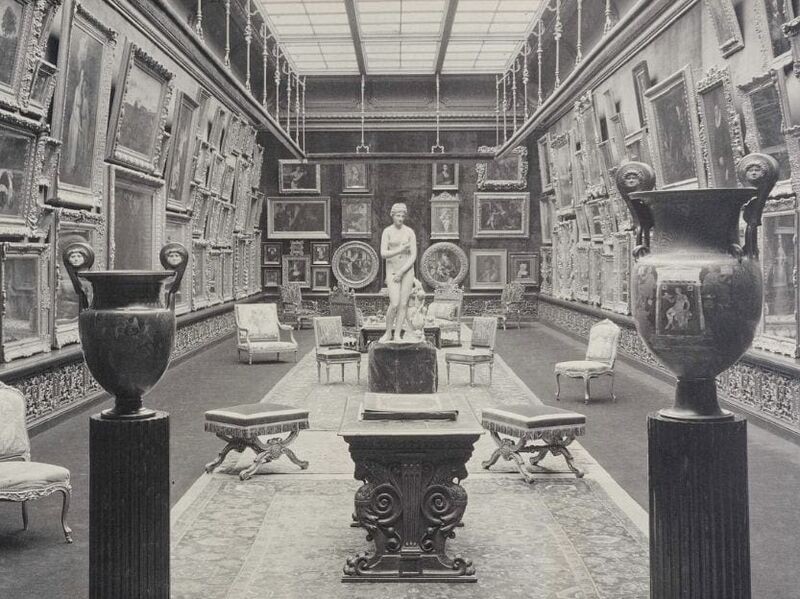
Third son Joseph, who was living on the grounds with his family, ran the estate up until 1942. During that time, Joseph would open the vast—and expensive—art gallery to the public in June and October. Joseph donated over 2,000 pieces of art to the National Gallery of Art in Washington, DC. P.A.B. may have begun collecting art as a novice, but he along with Joseph built one of the largest and best private collections in the world. The pieces were on display throughout the house and grounds earning Lynnewood Hall the description: The House that Art Built. The collection was valued at nearly $50 million dollars in 1924.
Joseph died in 1943, and none of the heirs showed interest in maintaining a mansion of this scale. It sold for $130,000 in 1948 and again in 1952 for $192,000 to the Faith Theological Seminary, run by Carl McIntire. It has essentially been abandoned since 1952. However, another religious organization, First Korean Church of New York, is the current owner. When the church was denied a property tax exemption on the 33-acre property, the church decided to sell. The mansion initially listed at $20 million dollars. The last time it was online for sale, it was priced at $11 million. That listing has been deactivated.
The house may be salvageable. At least for now. If I had the connections, I would form a company to purchase the building and land and set about rezoning for multiple housing, whereby people can purchase expansive condos in the subdivided building and create a subdivision honoring the past while providing the necessities of today. There once was an electricity plant on the original property. I would get it back up and running.
My dream may not be too far off the mark. I’ve read of one developer seeking to create a high-end B&B model for the uber wealthy. I’m unsure that is the demographic who would love the opportunity to explore. Personally, I think the cash cow option is paranormal investigations to see if the “ghost” stories of three gentlemen haunting the estate are true.






















 The Haunted Librarian
You must be logged in to post a comment.