• About
  • Archer Paranormal Investigations (API)
  • Contact
  • Media
  • The Haunted Librarian Show

The Haunted Librarian

~ Researching, investigating, and writing about the paranormal.

The Haunted Librarian

Category Archives: Folklore

It’s that Time of Year…Krampus Night!

22 Saturday Nov 2025

Posted by The Haunted Librarian in Folk Tales, Folklore, Folktales

≈ Comments Off on It’s that Time of Year…Krampus Night!

Tags

#Krampus

Check out my updated blog on Krampus, https://thehauntedlibrarianfl.substack.com/p/krampus-the-christmastime-monster.

Happy Walpurgis Night (Walpurgisnacht)

01 Monday May 2023

Posted by The Haunted Librarian in Folk Tales, Folklore, Folktales, Germany, Not Haunted, Not Haunted--But Cool

≈ 1 Comment

Tags

walburgis, walpurgis

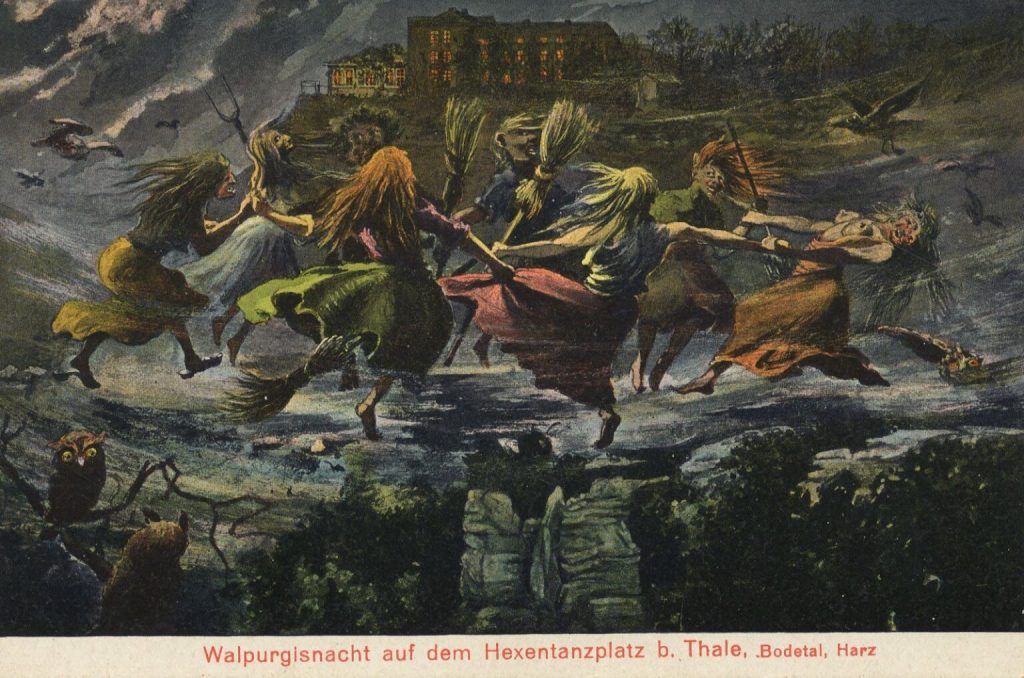
Walpurgisnacht is a German night of the witches. Here are 9 facts about the Second Halloween holiday and the English nun who helped transform the holiday:

  1. The pagans welcomed spring and fertility rights at the end of April. They held ceremonial festivities to celebrate the end of winter. In Germany, these locations were remote to avoid detection.
  2. Mount Brocken is the highest peak in the Harz Mountains where the Witches’ Sabbath took place. In medieval times, a wild party was held to celebrate the devil Wotan’s marriage to Freya.
  3. An English nun named Walpurgis (sometimes spelt Walburgis or Walpurga) moved to Germany to rid the people of pests, illnesses, and witchcraft. Born in Devon, England in 710 A.D., Abbess Walpurgis died on February 25, 777/779. She was buried beside her brother, Saint Willibald, at the church in Heidenheim where it fell into ruin. She was canonized on May 1, 870 A.D. When workers accidently desecrated her tomb, Walpurgis appeared to Bishop Otkar in ghostly form and threatened him. By September, her remains were removed and reinterred in Eichstatt.
  4. In 893, Otkar’s successor Bishop Erchanbold opened the tomb to collect some relics when he observed Walpurgis’ body immersed in an oily dew. The oil is bottled in small vials and sold as having healing attributes even though chemical testing shows it is composed of water.
  5. Saint Walpurgis is credited with ending paganism in Germany. This did not last. Many pagans celebrate Walpurgisnacht annually. Initially, people would dress up, make loud noises, hang sprigs, and leave out Ankenschnitt (bread with butter and honey) out for the phantom hounds.
  6. Today, the celebration is more inclusive and incorporates fireworks and bonfires. The holiday begins on the night of April 30 and runs through the next day, May 1.
  7. Walpurgisnacht is similar to Halloween as both evolved from pagan practices linked to the changes of the seasons. That is why Walpurgisnacht is considered the Second Halloween.
  8. These festivities are not isolated to Germany but are held through northern Europe.
  9. Walpurgisnacht is not May Day (May 1st) or Beltane. Those are separate holidays.

America’s Last Vampire Exhumation: Mercy Lena Brown

16 Tuesday Nov 2021

Posted by The Haunted Librarian in Cemeteries, Folk Tales, Folklore, Folktales, Vampires

≈ Comments Off on America’s Last Vampire Exhumation: Mercy Lena Brown

Tags

consumption, edwin atwood brown, tuberculous

In the late 1800s, America was in the midst of a vampire panic. This was directly linked to the outbreak of tuberculous, or consumption as it was called then. The undereducated citizens didn’t understand epidemiology. And people, especially those in rural communities, distrusted medical doctors. It was easier to believe that a person who died from consumption yet seen walking through the cemetery was a vampire than to come up with another, more logical reason, for supposed hauntings. Thus was the case of Mercy Lena Brown, forever known as the “Last New England Vampire.”

Throughout history, civilizations battled outbreaks of horrible and deadly diseases. In the 1800s, it was tuberculosis, also known as TB. At that time, there wasn’t a cure for TB. The survival rate was 20%. Entire families were decimated. And towns attempted to thwart and to explain why people were dying.

In Exeter, Rhode Island, George and Mary Eliza Brown were farmers. They had 7 children, 6 girls and 1 boy. On December 8, 1883, Mary Eliza succumbed to TB. By June 6, 1884, the eldest daughter Mary Olive (2.17.1864-6.6.1884) was dead, as well. Both were properly interred into the family plot, resting in peace in the ground.

When Edwin Atwood, age 24, became ill, he and his young wife, Hortense, headed to a mineral spring in Colorado Springs, Colorado for 18 months. Edwin seemed to improve a bit; however, by the time he returned to Rhode Island, he had already relapsed.

By then, Edwin’s other sister Mercy Lena was ill. Born on August 2, 1872, Lena, as she was called, died on January 17, 1892, in the dead of winter. Her body was stored above ground and in a mausoleum. Edwin’s health was declining so much so that he began to hallucinate. He claimed that Lena was sitting on his chest. Others in the community started telling stories of seeing Lena walking through the cemetery. Within a very short time, vampire panic had taken over Exeter, and the community sought answers.

George Brown was placed in the precarious position of honoring his deceased daughter or allowing her to be exhumed. He was convinced of the latter. On March 17, 1892, Lena’s body was removed from the coffin, and the town folk gasped in horror. Unlike the decomposed bodies of Mary Eliza and Mary Olive, who were also exhumed, Lena’s corpse seemed fresh. It was documented that she lay on one side with blood still within her veins and heart. A mob mentality took hold. And they demanded an offering.

Regional superstition stated that the heart and liver of a corpse must be removed and burned to permanently kill the decedent. Lena was sliced open, her heart and liver removed, and set upon the blazing bonfire. However, that would not calm the folks.

Lena’s cremated remains were mixed with water to make a tonic that was given to Edwin to drink. And drink he did. Yet, it was to no avail. Two months later on May 2, Edwin joined his family in the Chestnut Hill Cemetery.

The surviving heirs retell this horrible violation and desecration by keeping Lena’s memory alive. On Decoration Day, now known as Memorial Day, when people visit and decorate the gravesites of relatives, specifically military members, relative tell her deeply dark tale.

Mercy Lena Brown’s death is a lesson. Pandemics happen. As we work to survive, we should look to the past. We should trust scientists, medical doctors, and epidemiologists. We should also know statistics. Even though vampires may exist (depending on the definition used), the odds of the recently deceased person actually being one is small. Very small. We should also let victims of these heinous desecrations rest in eternal peace.  

What Are Puk-Wudjies?

26 Tuesday May 2020

Posted by The Haunted Librarian in Folklore, Native American Indians, Puk-Wudjies

≈ Comments Off on What Are Puk-Wudjies?

Tags

Freetown Fall River State Forest, Pukwudgie

As you know, I listen to Midnight.FM Mondays-Fridays, 10 PM – 1 AM. During the broadcasts, I chat with others in the Discord server, paint, and take notes. Frantic notes. I am learning so much and enjoying all the guests. I make it a point to learn one new tidbit of knowledge, and tonight it was the Puk-Wudjies.

Through my online research, I’ve tracked down two variations of this magical creature. The first is deeply rooted in Native American and Northeastern folklore. The second is an offshoot of the popular Harry Potter universe. I am limiting my research to the former.

Puk-Wudjies go by different names. A lot of different names, in fact. The most common spellings are Puk-Wudjie, Puck-Wudj-Ininee, and Pukwudgie. The name translates to “person of the wilderness.” They are woodland creatures standing 4-5 feet tall. They possess human heads; however, their noses, ears, and fingers are much larger. Their skin is a smooth grey.

Native Americans believe that the Puk-Wudjies were once humans who turned against man to live in solitude in the forests. In the Algonquian folklore, they are tricksters who are dangerous. Their mischievous behavior may turn mean. The Ojibwe tribe views them as good-natured. Yes, they are tricksters, but the tricks rarely turn malicious.

Poet Henry Wadsworth Longfellow mentioned them in his 1855 epic poem The Song of Hiawatha. They are akin to fairies and gnomes, supposedly.

I’ve never encountered a Puk-Wudjie. However, one place where I might see them is in the Freetown Fall River State Forest in Massachusetts. In 2017, the Freetown Police Department posted warning signs fearing that these magical creatures may be the cause of increased car crashes. The sign warns drivers of their presence as they appear and disappear at will. Hikers will notice the woodland creatures as they usually carry poisoned arrows in their rucksack. The signs were posted during the Puk-Wudjie mating season: April Fools’ Day.

Although some may see the sign as a prank, the police department sought a way to slow drivers down as the number of crashes had indeed increased.

Residents of Delaware seem to spot the Puk-Wudjie, as do the Wampanoag tribespeople. Maybe once we can move around the country, I may plan a road trip up and see if I can spot one. Until then, I’ll keep reading up on these fascinating woodland creatures.

La Popular’s Corpse Bride La Pascualita

29 Wednesday Apr 2020

Posted by The Haunted Librarian in Dark Tourism, Folklore, Mexico

≈ Comments Off on La Popular’s Corpse Bride La Pascualita

Tags

Chihuahua Mexico, Pascuala Esparza, wax figures, waxworks

With travel on hold due to the COVID-19 pandemic, I’ve become an armchair traveler. I browse the Internet looking for strange destinations to place on my bucket list. I came across the Mexican folktale of La Pascualita, the bride who stands in the showcase, in downtown Chihuahua, Mexico. Her story is too good to be true.

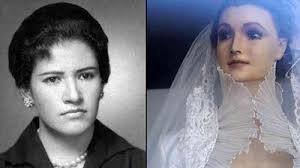
Although some blogs suggest that La Pascualita is an embalmed corpse, she’s not. There are several explanations for why she looks so lifelike, and none of them are due to embalming fluids. She is, nonetheless, a stunning waxwork.

Local legend claims that she appeared in the bridal store’s window on March 25, 1930. She wore a gorgeous spring wedding dress, just in time to celebrate Easter weddings. (Easter fell on April 20 in 1930) It should be noted that the name “Pascuales” means “Easter” in English. “Esparza” translates into “sprinkle” or “scatter.”

According to the legend, the shop owner, Pascuala Esparza, had a daughter who was to be married. Neither the name of the daughter nor the bridegroom are reported. (Hmm.) On her wedding day, the bride-to-be was bitten by a Black Widow spider and died. Shortly thereafter the mannequin appeared in the window.

Local residents compared the mannequin to the shop owner’s deceased daughter. They do favor each other; however, this proof that the mannequin is the actual corpse bride.

Since then, people claim the mannequin changes positions during the night. People also report that her eyes follow them down the street. An even more fantastical story is that a magician from France visits, placing a spell on her or awakening her from her slumber so they may dance the night away.

There are huge plot holes in the story.

First, there are questions whether there was a shop owner named Pascuala Esparza. I can tell you that FindAGrave.com does not show any burials for a person with that name or any variations.

Next, we have the images of La Pascualita, which translates into “her daughter” or “little daughter.” Would the name translate to “little daughter of Easter”?

Certain staff members change the clothing twice a week. This is done behind heavy curtains. One employee says she dislikes touching the waxwork. This explains why some people think the mannequin moves. She does. Only she moves with the assistance of employees.

Waxworks are known to have roving eyes. This is on purpose. The eyes of wax figures are glossy. They are meant to appear real, and our minds convince us that the eyes are following us.

Also worth noting is the date March 25. In the Roman Catholic Church, March 25 is the Feast of the Annunciation, where the archangel Gabriel tells the Virgin Mary that she will deliver a child who shall be the son of God. The religious day is oftern called “Lady Day.”

I’m wondering if someone was trying to infuse a lot of symbolism into the mannequin. Hopefully, one day I will be able to visit and to see for myself.

Registered Trademark

The Haunted Librarian

The Haunted Librarian

The Haunted Librarian

Gainesville, Florida

Enter your email address to follow this blog and receive notifications of new posts by email.

Archives

Categories

Top 50 Paranormal Blogs & Websites

Top 15 Paranormal Blogs of 2019

Banners for Top 15 Paranormal Blogs of 2019

A WordPress.com Website.

  • Subscribe Subscribed
    • The Haunted Librarian
    • Join 646 other subscribers
    • Already have a WordPress.com account? Log in now.
    • The Haunted Librarian
    • Subscribe Subscribed
    • Sign up
    • Log in
    • Report this content
    • View site in Reader
    • Manage subscriptions
    • Collapse this bar
 

Loading Comments...
 

You must be logged in to post a comment.