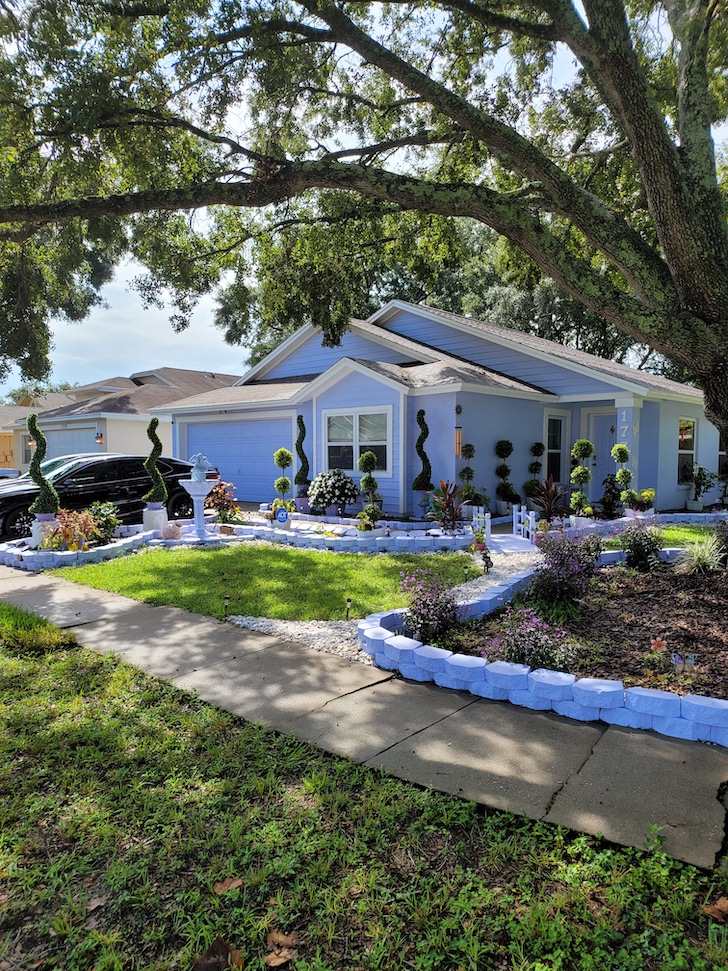
In 1990, director Tim Burton transformed the Carpenters Run neighborhood into a bizarre movie set for the film Edward Scissorhands, starring Johnny Depp and Winona Ryder. Although the houses have aged and regressed back to the typical Florida décor, the neighborhood has attracted fans since. On September 11, 2020, Joey and Sharon Licalzi won a bidding war and paid $230,378 for the 3 bedroom/2 bath 1432 square foot home. They’ve transformed it back into the movie set and have opened Scissorland, a free museum.
Edward Scissorhands (1990) is a cult classic. Filmed on a $20 million dollar budget, it grossed $56 million in the U.S. and $86 million worldwide. Deemed one of Burton’s best (aren’t they all?), the film was a fantasy-romance hybrid that told the story of Edward, the man with scissor hands. The movie is currently streaming on Hulu.com.
Movie posters for the 1990 film.
Fast forward 30 years and you can see how the neighborhood changed. Gone are the pastel color exterior house paint and topiary scrubs. However, Joey and Sharon have started the transformation.
1-2. Street as it appeared in the movie.
The exterior is now a pastel blue, and the front yard is adorned with topiaries. The backyard is a whimsical playground. The original owner saved the mushroom wallpaper, which the couple reinstalled. They offer the home with the growing movie memorabilia as a free museum. Outdoor movie screenings will begin when the weather cools.
1. House as it was painted when sold in 2020. 2. The transformation. 3. Mushroom wallpaper. 4. The backyard.
The memorabilia are an eclectic collection. There’s a license plate that the residents had to place on their cars for filming. A pack of cigarettes supposedly belonging to Depp is on display, along with an endearing mannequin dressed as Depp’s character. The collection continues to grow.
Although reservations are not required, I encourage those wishing to visit make them. Remember, not only is the house a museum: the couple actually resides there. The address is 1774 Tinsmith Circle, Lutz, Pasco County, Florida.
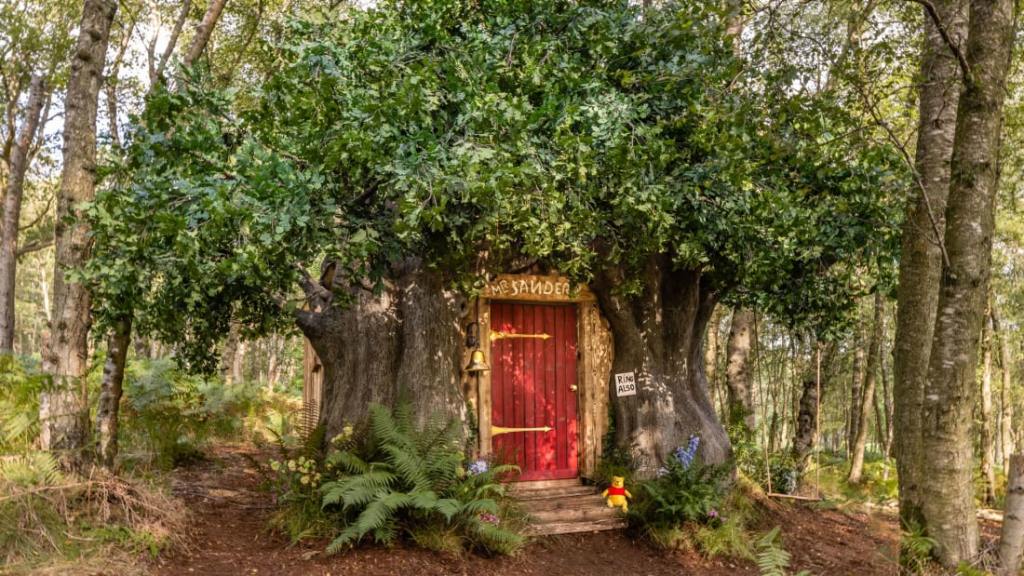
Illustrator Kim Raymond incorporated small details into the house.
Two lucky residents of the United Kingdom will spend £95 to spend one night in Winnie the Pooh’s house. The open dates are September 24th and 25th, which coincides with the 95th anniversary of A.A. Milne’s first publication of the adorable honey loving bear.
The one-room house has all the hallmarks of Pooh’s house. Kim Raymond, who has illustrated the Pooh books for 30 years, incorporated small details into the construction of the house, which sits along the Ashdown Forest in East Sussex, England. A.A. Milne lived here and based his famous Hundred Acre Wood on the forest.
Two lucky U.K. residents will enjoy the comforts of Pooh’s house and Hundred Acre Wood.
The guests receive a guided tour of the wood, along with honey-inspired meals. They will also play Poohsticks on Poohstick Bridge and enjoy naps in the cozy beds.
The outside façade has Pooh’s tree and the “Mr. Sanders” sign. The mystery surrounding who Mr. Sanders was remains; however, the house has been beautifully realized. I hope that the house will be open on future dates for international tourists.
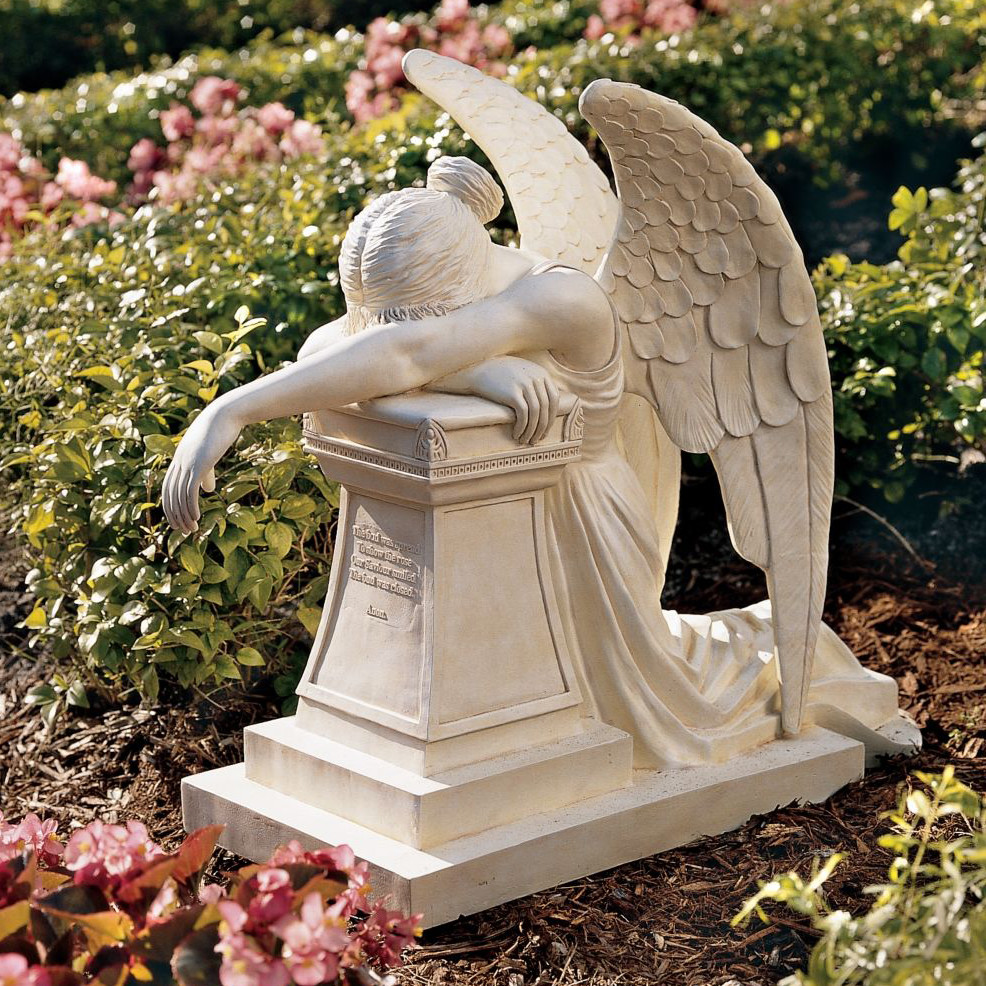
TheAngel of Grief, as it is known, is one of the most iconic funerary sculptures that exist. It is also one of the most copied. The original was created by American lawyer, poet, and sculptor William Wetmore Story. TheAngel of Grief would be his last major work and lovingly dedicated to his recently deceased wife, Emelyn. It captures the grief he experienced at the prospect of living without his spouse.
William Wetmore Story (1819-1895) saw an opportunity to quit practicing law and become a full-time artist. He was the son of Associate Justice Joseph Story (1779-1845) who served on the Supreme Court of the United States, also known as SCOTUS. William graduated from Harvard College and began his career in law. He was successful but unfulfilled. When his father died, William accepted an offer that changed the course of his life.
A committee set up to honor the late Justice Joseph Story wanted to commission a statue in his memory, and they asked William to create it. William was a hobbyist and accepted the commission as long as he and his family moved to Italy for him to study.
William Wetmore Story (1819-1895)
By this time, William and Emelyn nee Eldredge had married and started a family. They had two children: Edith “Edie” Marion and Joseph “Joe.” And so, the family moved to Rome, Italy where William embarked on an apprenticeship. Tragedy struck the young family when little Joe died from gastric fever on November 23, 1853. He is buried in Campo Cestio in Rome.
The family grew while William honed his craft. Thomas Waldo, born December 9, 1854, and Julian Russell, born on September 8, 1857, joined older sister Edie. (Note: All four surviving children embarked on careers in the arts: T. Waldo became an acclaimed sculptor; Julian was a famous painter; and Edit, known as the Marchesa Peruzzi di Medici, became a writer.)
1. Thomas Waldo, who went by T. Waldo or simply Waldo. 2. Julian. 3. Edith Marion, the Marchesa Peruzzi di Medici.
Although William returned to the United States to erect the monument for his father, he would make Rome his home. During the forty years he and Emelyn resided in Italy, William created other famous sculptures and gained acclaim as a poet. They enjoyed life and each other.
Emelyn died in 1894, and William’s heart broke. He prepared and created one last sculpture: The Angel of Grief. An angel dressed in Roman attire drapes her body over the altar with her large wings slumped in despair. The sculpture personified the grief that embraced William.
William died in his sleep a year later. He is buried beneath the sculpture with the love of his life. The monument sits in Campo Cestio, also called the Protestant Cemetery or the Cemetery for the Non-Catholic Foreigners. It may be viewed during posted business hours. If you’re unable to see it in person, you can visit some of the copies in America. I cannot state if the cemetery is haunted; however, I can tell you that it has some of the most beautiful funerary monuments that I’ve ever seen in one location. It also has about 40 cats that roam the cemetery listening to classical music when the cemetery closes for the day. Well worth a visit, in our post-COVID world.
While researching this article, I wanted to find a photograph of Emelyn; however, I was unable. There are a few of William and his children who survived into adulthood, but nothing for Emelyn. That is also heartbreaking. I would love to see the woman who supported and encouraged her husband to create so many famous pieces of art, especially the most important piece that is one of his most well-known.
The woman in this photograph is believed to be Emelyn; however, it is not verified.
Growing up in Fort Myers, I was fortunate to have parents who owned a boat. We would spend weekends out on the water, eating on Little Shell Island, and motoring up and down the Gulf of Mexico. When we were making it an all-day affair, we would head down to Collier County and look at the three odd houses perched on Cape Romano. The most famous was and remains the Dome House.
I didn’t appreciate my youth living on a canal where manatees swam and seahorses grew until I left. I guess that’s the age-old adage. Many years later and well into my adult life, I was able to spend the day on the water sailing past Cape Romano. While the Pyramid House and the Stilt House are long gone, the Dome House remains.
Bob Lee made his fortune in the oil industry which led to his ability to retire at the age of 44 and become an inventor. He envisioned an eco-friendly home where his family could vacation. The home would be off the grid and powered with renewable energy. He first built a prototype on his property in Gatlinburg, Tennessee.
In 1978, Bob purchased four lots on Morgan Island in the Ten Thousand Island chain south of Marco Island, Collier County, Florida. The island was pristine, unlike the rapid development taking over Marco.
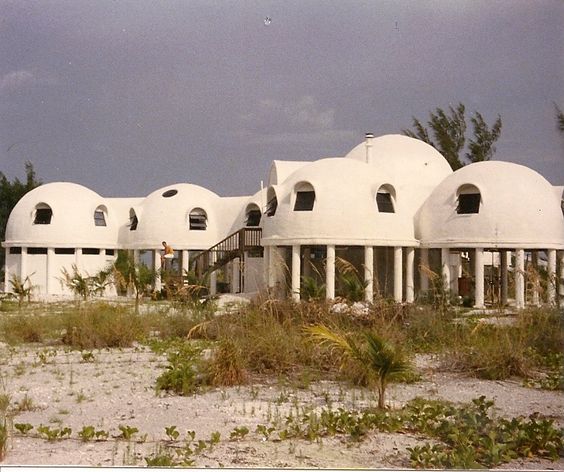
Bob decided to build a home linking 6 dome structures all perched on cement stilts. Bob bought a barge, a flat motorized water vessel that easily transports equipment, and ferried over steel forms (molds) and 2 concrete mixers. He mixed the concrete with freshwater and built the domes. Bob installed under-dome heating via fire; the walls were insulated with foam. Dell Jones installed solar panels. Along the bottom of each dome was a gutter system the collected rainwater which was filtered for use.
If the house seems rustic, you’re wrong. It was actually quite lavish. Pinterest has a large collection of images. Carpet and tile were laid for flooring. There was air conditioning, satellite TV, and even a hot tub. It was the perfect vacation getaway.
Interior photographs.
The 2400 square foot 3-bedroom and 3-bathroom house was completed in 1982. Bob along with his wife Margaret and family enjoyed two years at the house. In 1984, Bob sold the property to George Wendell. Caretaker Brian Slager moved into the house. By 1987, the house was back in Bob’s name, and the family made it their primary residence.
John Tosto of Naples purchased the lots in 2005 for $300,000. He sought to develop and protect the home. Bob encouraged building a seawall; however, it was too late. The island was eroding beyond conservation.
Mother Nature has not been kind to the island chain. All three houses had generous beach sand buffering them from the water. Over time, erosion and natural weather phenomena took away the sand. In 1992, the category 5 Hurricane Andrew destroyed the interior of the Dome House. By October 2005 when Hurricane Wilma churned past, the sand was eroded further. Two of the 6 domes fell on September 10, 2017, in Hurricane Irma.
1. Damage from Hurricane Andrew; 2. The Dome House sits abandoned.
After several years in court battling the land use of the Dome House, the State of Florida now owns the land while Tosto owns the structures. The house sits in the water and has become part of the Rookery Bay Aquatic Preserve. It is a destination for tourists and urban explorers. Sea creatures and birds have made it their home. Nature has reclaimed what was always hers.
The house is viewable only by water. As the erosion continues, there are growing fears for the safety of boats attempting to anchor or to sail close. Hire a licensed boat captain or company to sightsee. Never attempt to trespass.
1. The 3 houses on Cape Romano; 2. The backside of the house; 3. The aviaries; 4. The front.
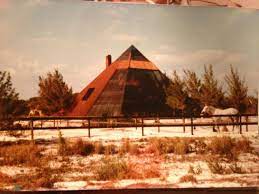
Cape Romano is an island just south of Marco Island, off Naples, in Collier County, Florida. Back before climate change was mainstream, people purchased lots of these fragile islands and built houses. Of the three on Cape Romano, the Dome House is the most famous. (Blog forthcoming). However, personally, I’m captivated by the Pyramid House. Not only did the family live in the structure, they brought their pets to join them in island bliss…until it wasn’t.
Cape Romano is the southern point in a chain of islands making up the Ten Thousand Islands off just south of Marco Island. At some point in the 1060s, entrepreneurial salesmen decided to sell plots on the beach facing the Gulf of Mexico. This was Florida’s “I’ve got a bridge to sell you” land scam. It was also before climate change became our generations danger.
Montague “Monte” Innes convinced his wife, Judy, that he could build a house on the island where they could live an almost off-the-grid lifestyle. And it worked for several years.
According to a recent interview with Judy, the plot was on Caxambas Island, part of the Ten Thousand Island chain. (Note: the landscape of the island chain has substantially shifted with erosion. The island boundaries have changed over the years.) Monte purchased a barge to bring over the supplies and with the assistance of a friend named Harry, they constructed the 3-story cedar pyramid-shaped house.
Honestly, Monte, and with the Dome house builder Bob Lee, were decades before their time. Both men devised ways for the families to survive and thrive with solar power for Bob and windmills for Monte, generators, and water filtration systems. Judy and Monte even had a waterbed! Monte used extra pilings to secure the floor.
The house had rooms butted against the front wall and a large 3-story lanai along the back. What made the Pyramid special were 4 golden mirrors placed upon the top. Sunshine reflected off the mirrors, resembling the Egyptian pyramids. The other feature consisted of a menagerie of animals Judy kept. Monte built 5 aviaries for Judy to breed birds. Five emus had full run of the island.
Online forums house postings from people from all over who passed via boats the homes while growing up. As the homes were only accessible by watercraft, the homeowners had to bring over supplies and animals on barges. The horses are the most discussed topic. Judy brought over two horses, Notice Me (Twiggy) and Koko individually in a horse trailer fastened to the barge. They arrived in 1978. By May of 1987, Judy removed the horses and relocated them to her Naples property.
1. Bringing each horse over on the barge; 2. The horses with the house in the background.
The youngest daughter, Heather, was a high school student while residing on the island. Each school day, she took a small John boat to Marco Island to get to school. What an incredible life!
In 1988, Judy was injured while riding a horse and never returned to the island. Monte and Judy divorced; Heather would look after the animals and began to bring them to mainland.
Shortly after Judy and Monte sold the pyramid house to a couple from Ohio, it sustained great damage from a hurricane. Judy says a tornado brought down the house.
Erosion, however, was always on their minds. When they constructed the pyramid, there was roughly 2,000 feet between the house and the water. Rapid erosion quickly diminished the distance, and then Mother Nature finished it off.
The area is not haunted—that I know of. However, it is a part of my childhood, having seen the houses and heard the talk, and I wanted to share that Florida is known for some odd things. And a cedar pyramid on an island in South Florida is one of them!
Marco Island is the populated area on this aerial map. Cape Romano and the islands are to the right.
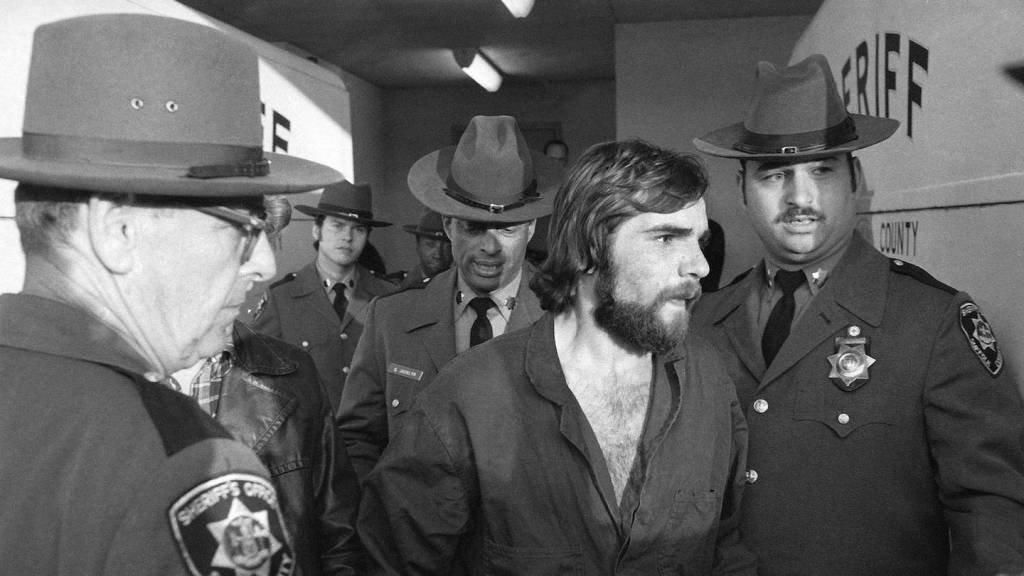
1. Undated photograph of the DeFeo family. 1. The exterior of the infamous house. 3. Ronald “Butch” DeFeo, Jr. in handcuffs.
Ronald “Butch” DeFeo, Jr. is dead at the age of 69. On November 13, 1974, DeFeo murdered his parents and 4 siblings. One of his defense theories was that he was possessed at the time. The Court did not entertain the idea. Instead, DeFeo was sentenced to serve 25 years to life. On February 2nd, he was transported to the Albany Medical Center, and his death was reported on March 15.
The combination of a horrible crime coupled with the farfetched defense theory spawned one of horror movie genres most successful and lucrative franchises. However, it was build upon a hoax. (See my blog from 2014: https://thehauntedlibrarian.com/2014/03/19/amityville-horror-hoax/)
Prison officials nor the hospital provided a cause of death stating that one would be released only to immediate family. We may never know how he died. Honestly, I’m okay with that. Let’s focus on the victims instead.
The Withybrook shrunken medieval settlement dates back to the 12th century. One of the earliest structures, the All Saints’ Church, was restored in 1995. The area is deserted; however, it contains significant ancient monuments and is protected under the British Ancient Monuments and Archaeological Areas Act of 1979. It is also privately owned. The owners were recently fined £160,000 pounds for unauthorized destruction.
Withybrook is located in Warwickshire, England. Government documents show that people inhabited the area as far back as 1188. The area is now deserted and co-owned by mother and daughter, Heather and Elizabeth Mac. Along with Heather’s husband, John, they began excavating an area by ripping out plants, grading the land, and installing plumbing. The intent was to set up a yard for horses to graze. All of the work was unauthorized. The family were issued several warnings. They refused to stop.
Community residents appealed to the government. The Warwick Crown Court issued £160,000 pounds in fines and court fees. The Court cited the family’s lack of remorse for the high fines. They have until September to pay or face up to 14 months in jail.
Historically designated sites are important. The designations ensure preservation of culturally significant properties. Owners are well educated in the laws and know what can and cannot be done. Any changes must be approved by governing bodies. Although the Mac family are probably not the only people to commit heritage crimes, they received some of the highest fines known.
The Wyckoff Villa is not haunted. Further, stating that it is hasn’t help sell it. The abandoned structure has been on the real estate market since 2012, and still, no one bites.
Less than a mile south of the Canadian border sits Carleton Island. The island sits within a chain of islands in the St. Lawrence River known collectively as Thousand Islands. Accessible only by boat, the island has three burial grounds and 34 homes. The most infamous home is Wyckoff Villa, also known as Carleton Island Villa.
Wyckoff Villa was intended to join the ranks of other stately mansions on the other islands. Architect William Henry Miller designed the 15,000 square foot home, and building commenced in 1894. The owner was former Union Captain William Ozmun Wyckoff. Wyckoff returned from the Civil War to become a lawyer and court stenographer. Through the stenographer’s job, Wyckoff learned about a new invention: the typewriter.
Typewriter. ME*311041.
The first commercially successful typewriters were sold by E. Remington and Sons in 1874. William Wyckoff began selling the typewriters on a part-time basis, eventually leaving his court-appointed stenographer position to form the Wyckoff, Seamans & Benedict company. In 1886, Remington sold the entire typewriter division to Wyckoff, Seamans & Benedict, and William became the company president. Wyckoff became a typewriter tycoon.
Shortly thereafter, Wyckoff and his wife, Frances Valeria Ives Wyckoff, began searching for a location to build a summer home. They settled on Carleton Island.
However, tragedy would follow. Construction progressed through 1894 and into 1895. A month before the home was ready, Mrs. Wyckoff died. On June 1, 1895, Frances died from either cancer or a heart attack (depending on the source). William moved into the enormous home on July 11th. He suffered a heart attack that very night and died.
No one would reside in the home again. The 11-bedroom, 50 room home sits on 6.9 acres. General Electric purchased the land, seeking to demolish the home and build a corporate resort. World War II placed the development on hold, eventually tanking the project entirely in the 1940s, when the company gutted the interior. Fixtures and material were stripped from inside. In fact, the marble underneath the 5-story tower was removed, thus causing the structure to become structurally unsound. The tower was eventually torn down.
The current owners have marketed the home as a tear-down (versus a fixer-upper as it would cost a reported $10-15 million) with the waterfront land sub-divided for future homes. The realtor receives weekly enquires; however, no one seems to want to purchase. Some media sites have labeled the villa as haunted.
The villa is not haunted. There isn’t one credible story claiming that the house is haunted. It has been described as creepy and spooky, which may be the case, but there aren’t any reliable stories showing evidence that the villa is haunted. Here, the lack of evidence is clear.
What is not clear is why no one has purchased the lot with the villa or any of the other lots. The price tag may be a reason; it is listed for $495,000. Or it may be that there aren’t any year-round residents or paved roads.
According to Airbnb, novelty lodgings are up 70%. Seems people want to spend the night in odd locations. Beginning next month, travelers can stay at the iconic Lucy the Elephant.
Lucy’s story is complicated. Lucy was built in 1881 by James V. Lafferty in Margate City, New Jersey. Her designs are even patented. In 1902, a family of 6 rented her for their home. They renovated her interior and added a second floor. Unfortunately, she endured natural disasters and abandonment.
Lucy the Elephant became a roadside American attraction. In 1969, Lucy was slated for demolition but salvaged by a group of local residents. By 1970, the Save Lucy Committee, LLC was formed, and Lucy was saved. She moved to a city-owned property and restored. Over 132,000 tourists visit her annually. Now she has become an Airbnb listing.
Through a partnership with Airbnb, which provided a generous donation as well as furnishing the interior, and the Save Lucy Committee, tourists may book overnight stays within her belly. The cost of $138 per night denotes her age. The price includes a gift certificate to a local restaurant for dinner, breakfast, and a mobile bathroom parked beside her.
Lucy truly is an iconic piece of Americana. In addition, she is designated as a National Historic Landmark. Although Lucy is not haunted, she makes for an interesting destination. Bookings begin March 5th. For more information, visit airbnb.com/lucy.
Comfort Station No. 1; Vintage image from 1979 of station; Vintage postcard of St. Mary’s Catholic Church.
A story is making the Internet rounds claiming that Comfort Station No. 1 in downtown St. Petersburg, Florida is haunted. It’s not. However, its lack of ghosts should not detract from the stunning architecture that makes it one of the most beautiful and historic public restrooms in the United States.
St. Petersburg experienced large tourism in the 1920s. Hotel construction rose as people came to enjoy the warm winter weather. Architects drew inspiration from Europe building such historic hotels as The Hotel Cordova (1921), the Don CeSar Hotel (1928), and the Vinoy Park Hotel (1925). Shortly after designing the Vinoy, architect Henry L. Taylor (1884-1958) designed Comfort Station No. 1.
At the corner of 2nd Avenue and Bayshore Drive North sits an 8-sided brick building. Topped with Spanish tiles, the octagonal structure is modeled after the Lombardy Romanesque style. Although this is not Taylor’s most important architectural feat, it is one of his most debated.
Bids were taken in March 1927, with permits and construction commencing by the summer. It reportedly cost $16,000 and was completed and operational by May 10, 1928 when a Lost and Found ad ran in the St. Petersburg Times. Ironically, the person who ran the ad found a Masonic ring at the station. The February 1929 issue of The American City praised the facility—both functionally and aesthetically.
Urban legends continue to swirl. The first claimed that Taylor built the facility to resemble St. Mary Our Lady of Grace Catholic Church, situated at 515 4th Street South. Both structures are octagonal and share similar features. The story further claims that Taylor took umbrage to being shorted on the church project and designed the restrooms as an insult. This is factually incorrect. The bathroom was designed and built before the church, where construction began in 1929. Several newspaper articles, namely the September 9, 1992 St. Petersburg Times article, dispels this rumor.
Comfort Station No. 1 is sometimes called “Little St. Mary’s” or “St. Mary’s Comfort Station.” These are tributes to the similarities between the restroom and the church. While Taylor left no indication as to his reasoning on the design, some postulate that the restroom was a prototype for the large Byzantine style church.
One online tale also claims that Taylor himself haunts the station. Hardly. He built larger, more glamourous buildings to spend eternity.
Another Internet story refers to an elderly woman named “Agnes” who chats ladies up at the sink. After hours searching several online databases, I was unable to find an elderly woman who was alive in the 1930s (she reportedly was wearing clothes of that period) who died around the pier. Using a preconceived old-fashioned name doesn’t make the story true.
The comfort station sits along the retaining wall at the entrance to Pier Approach Park. Over the decades, the park consisted of several large piers: The Railroad Pier (1889); The Pier Pavilion (1895); The Electric Pier (1906); The Million Dollar Pier (1926); and The Inverted Pyramid Pier (1973). Engineers grew concerned by the saltwater erosion on the pilings; therefore, the pier is undergoing another rebuild/renovation.
There are numerous reasons why people hear sounds in the comfort station. First of all: it’s an oversized bathroom. The water lapping against the seawall also creates sounds. Hide tide, low tide; they all make waves. Boats entering/leaving the yacht basin. Acoustics against the tiles. Wildlife hovering about or scurrying underneath. In addition, fog and mist are frequent weather occurrences. Not one tale references actual investigations conducted to debunk.
Historic and old buildings are not necessarily haunted. I’ve visited this location numerous times (I used to live 16 blocks from here and would walk to the park). Never did I have an experience. Further, never did I hear about experiences. Visit Comfort Station No. 1 and reflect on a time when motorists did not have public conveniences and the one progressive city that took up matters by erecting a classic pit stop.
You must be logged in to post a comment.