

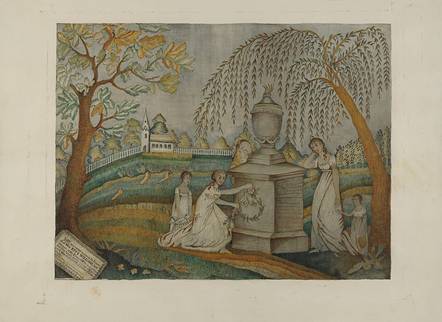
Source: Mourning Embroidery by Harry Jennings, 1935/1942. This file is made available under the Creative Commons CC0 1.0 Universal Public Domain Dedication. Accessed via Wikimedia Commons.
Mourning embroideries were popular in the early 1800s as a nationwide expression of grief when George Washington died in 1799. As the country mourned, many ladies took to hand stitching memento mori that included several funerary motifs. Examples are housed in museums and private collections. As hand embroidery remains popular, mourning embroideries may be a modern way to remember loved ones who have passed.
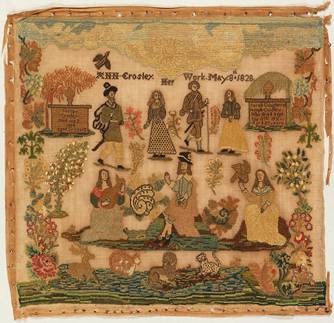
Source: Mourning Sampler, 1828 with later additions, unknown artist. Public domain because it was published (or registered with the U.S. Copyright Office) before January 1, 1931. Accessed via Wikimedia Commons.
Hand embroidery dates to 30,000 B.C. Chain stitching can be found in artifacts from China and India. Throughout history, embroidery was a symbol of power and wealth. In 18th century England, it was a highly markable skill for working class women. Samplers were utilized to gain experience and speed. While embroidery was confined to mending or marking for working class females, it was an artform for the wealthy.
Females growing up in wealthy families were taught the art of hand embroidery as a way to learn patience for running their own households. These women then carried on the skills in artistic creations. They had the time and money to indulge in this hobby.
The mourning embroideries incorporated common motifs for grief, death, and rebirth. Specifically, symbols of urns, weeping willows, anchors, roses, and angels were used in these creations. Some artists copied imagery then customized the fabric with names and death dates.
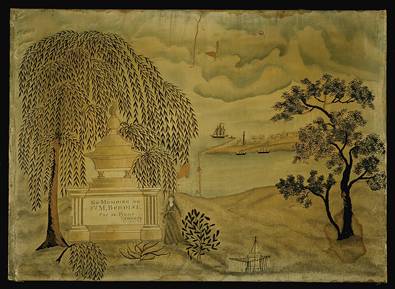
Source: Mourning Embroidery by Sophie Amanda Benoist, 1823. Made by Benoist to preserve the memory of her father, François Marie Benoist. This work is in the public domain in the United States because it was published (or registered with the U.S. Copyright Office) before January 1, 1931. Accessed via Wikimedia Commons.
The techniques were similar. One common method was: The artist painted onto fabric, usually silk. Then she embellished with satin stitches and French knots. The finished piece would be mounted onto a wooden panel. Jute and lace were added. Then the piece of art would be framed behind reverse-painted glass in a gilded frame.
By the twentieth century, machine embroidery production brought this hobby to the masses as mail order catalogs and patterns were readily available and inexpensive.
Hand embroidery is considered an art form, not a hobby. Embroidery falls within the needle craft classification, along with cross stitch, knitting, felting, and needlepoint. Statistics from 2016* show that needle crafting is popular and profitable with a market value over $1 billion dollars. According to those statistics, 71% purchase supplies strictly in brick-and-mortar shops, 8% solely online, and 21% shopping online and in physical stores. While 69% of needle artists are women, males do pursue this art form. A strong majority, 57%, prefer to keep their creations. Although the pandemic limited growth in this market, it is still healthy. The craft store chain Michael’s recently published their Creativity Trends Report for 2026 stating that internet searches such as “hobbies that can be taken outside to a park or on a train ride … are up 136% over the past six months alone.”
There are many online articles about mourning embroidery and needlework. Fortunately for us, several original pieces have survived and are preserved in several museums across the country.
*The 2016 statistics are the most recent published online.

 thehauntedlibrarian.com
You must be logged in to post a comment.